Chrome Tour vs. Kirkland Signature: Are the Gains Worth It?
Our head-to-head ball test shows where Kirkland Signature hangs tough, and where it falls behind.
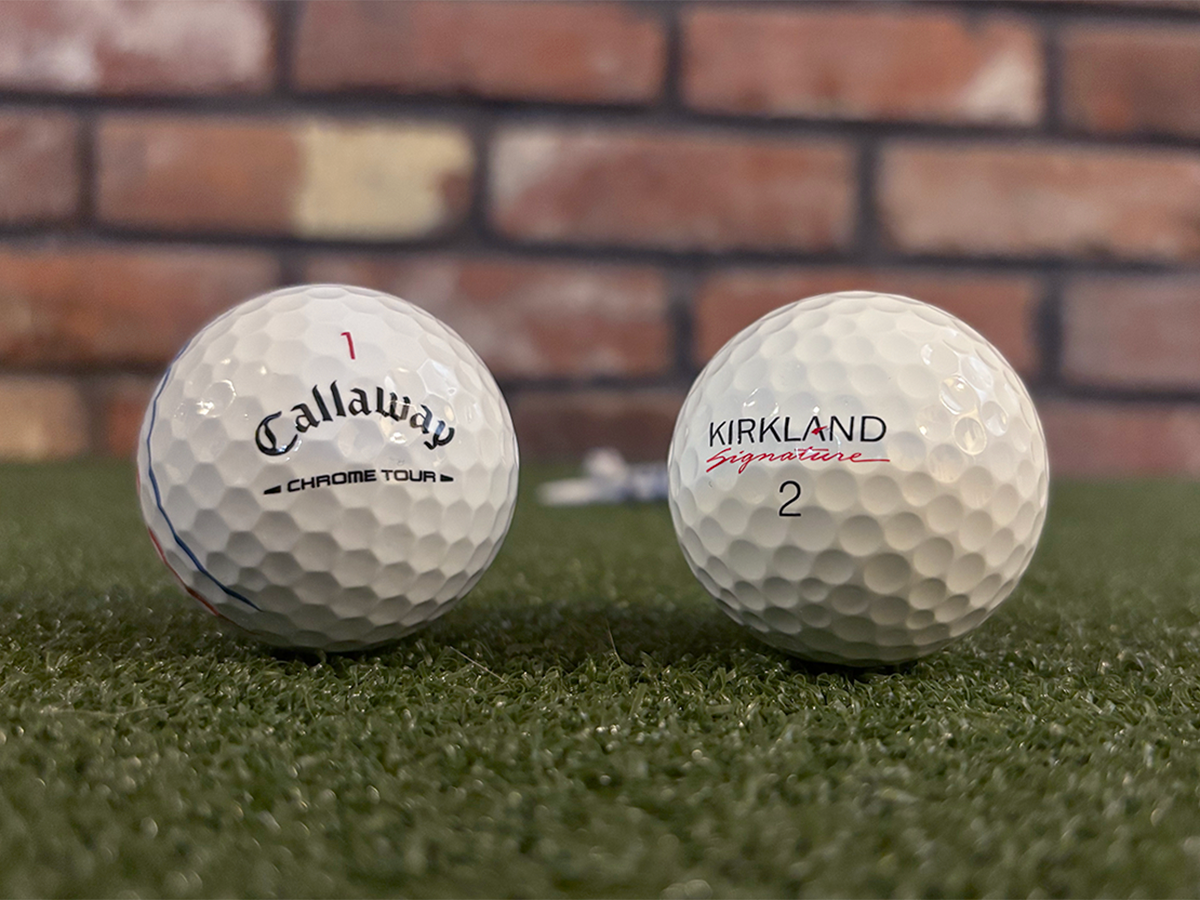
Callaway has made a huge push with its golf balls in recent years. Kirkland Signature balls have a reputation for good performance at a great price.
So what’s the difference between the 2026 Callaway Chrome Tour and the Kirkland Signature Performance+ golf ball? It turns out that the Kirkland Signature ball, affectionately known as the K-Sig, can hold its own in many ways. Our testing, however, revealed one key deficit that could be a deal-breaker even for the budget-conscious weekend warriors.
This golf ball comparison puts Kirkland Signature Performance+ vs. Callaway Chrome Tour. Here’s how they compare, and the performance differences regular golfers can expect to see on the course.
How We Tested
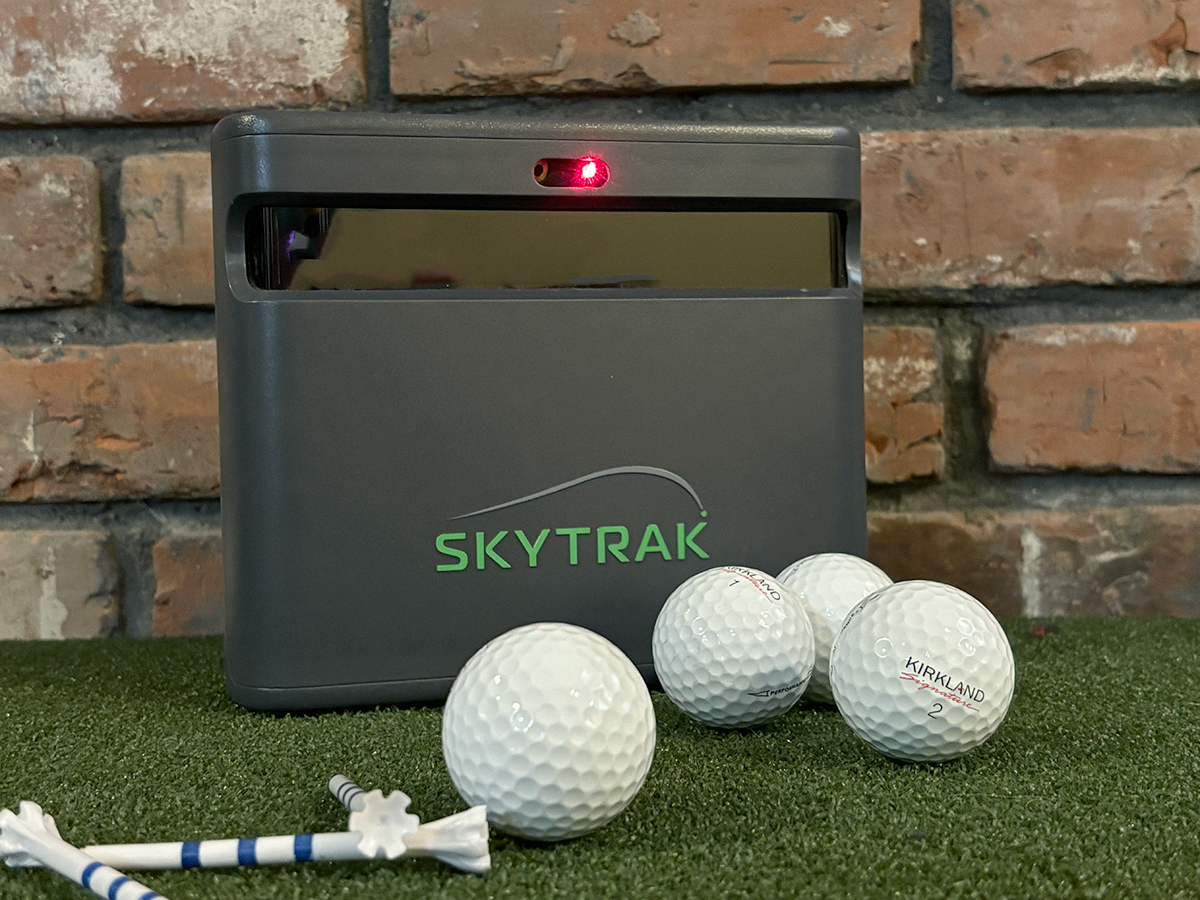
We tested both the 2026 Callaway Chrome Tour and the Kirkland Signature Performance+ using our standardized golf ball testing protocol using the SkyTrak ST Max launch monitor.
Instead of relying on robot testing that can separate distance down to the foot and spin down to the RPM, we use strict swing speed and impact-quality bands and human testing to evaluate each ball’s performance with driver, 7-iron, and a 50-yard shot. Then we assess performance in the categories that matter most: distance, stopping power, accuracy, and consistency.
We also evaluate standard deviation to gauge consistency. Standard deviation shows how tightly shots cluster. Lower numbers mean more predictable results.
Because we test with human swings, not robots, our results reflect how golf balls perform on the course with natural swing-to-swing variation. Learn more about how we test golf balls.
Callaway Chrome Tour vs. Kirkland Signature Performance+
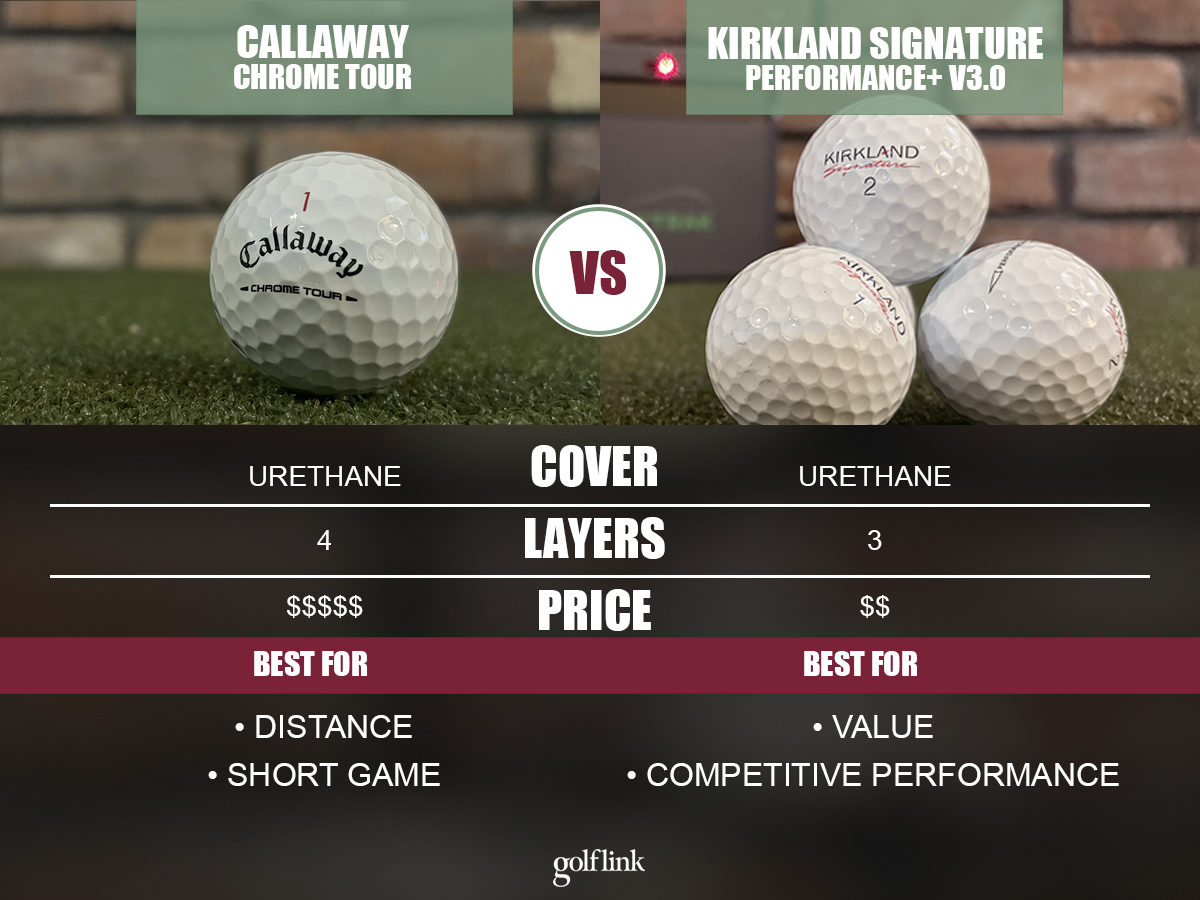
From the outside, these two balls appear to be similar. Both are multi-layer, urethane-covered balls built for premium performance.
Of course, there’s one major difference. The Kirkland Signature balls cost $21 per dozen (they’re from Costco, so you buy two dozen for $42), while a dozen Chrome Tour balls set you back $58.
If you’re shopping for a budget ball, it’s not a matter of if you’ll make sacrifices, it’s what you’ll sacrifice and how much those trade-offs are worth to you.
Here’s an overview of how the Performance+ compares to one of the category leaders, Callaway Chrome Tour, on the surface.
Callaway Chrome Tour Profile
Cover: Urethane
Layers: 4
Price: $58 per dozen
Kirkland Signature Performance+ v3.0 Profile
Cover: Urethane
Layers: 3
Price: $42 per 2-dozen
Driver Performance
|
Category |
Chrome Tour |
K-Sig |
Result |
|
Driver Distance (SD) |
240.8 YD (2.8) |
237.9 YD (2.7) |
Chrome Tour |
|
Ball Speed (SD) |
136.6 MPH (0.9) |
135.8 YD (2.3) |
Chrome Tour |
|
Spin (SD) |
2581 RPM (234) |
2732 RPM (308) |
No meaningful difference |
|
Side Spin |
171 RPM |
214 RPM |
No meaningful difference |
|
Apex |
22.3 YD |
22.5 YD |
No meaningful difference |
|
Offline |
13.9 YD |
8.3 YD |
K-Sig |
Callaway Chrome Tour proved to be the better of the two balls in our driver test, but how much those benefits are worth to you might be another story.
In our test, Chrome Tour was about three yards longer. When you consider the natural variance you should expect from one swing to the next with driver, that’s not necessarily a huge gap, but it’s sure worth considering.
Callaway also produced tighter standard deviations in ball speed, and side spin, proving to offer better consistency along with its win in sheer distance.
K-Sig, however, held its own. Spin was a touch higher, but at about 150 RPM, that difference is not meaningful. Peak heights were also nearly identical, and the K-Sig was actually the straighter of the two balls, finishing about five yards closer to the center, on average, with less side spin.
You could also argue (and some will) that at least some of the distance gap can be attributed to the 0.8 MPH difference in average swing speed during testing. That argument, however, won’t hold water when we check out the 7-iron performance.
Titleist Pro V1 vs Callaway ERC Soft: Which Fits Your Game?
Iron Performance: 7-Iron Test
|
Category |
Chrome Tour |
K-Sig |
Result |
|
Carry Distance (SD) |
163.6 YD (4.5) |
158.9 YD (1.9) |
Chrome Tour |
|
Total Distance |
174.0 YD |
168.1 YD |
Chrome Tour |
|
Spin (SD) |
4495 RPM (277) |
4621 RPM (321) |
No meaningful difference |
|
Apex |
23.0 YD |
23.4 YD |
No meaningful difference |
|
Descent Angle |
41.0° |
42.3° |
K-Sig |
|
Roll |
10.4 YD |
9.3 YD |
K-Sig |
|
Offline |
6.1 YD |
9.0 YD |
Chrome Tour |
In our test, Chrome Tour was longer and straighter, while the Kirkland Signature delivered more stopping power and better consistency.
Ball speed was the most noticeable difference between these two balls during testing. The K-Sig just didn’t want to jump off the club the same way that the Chrome Tour did. That resulted in a six-yard overall distance gap, which is too large to ignore, even in a human test. With swing speeds nearly identical (within one-tenth of a MPH), there’s nowhere for the K-Sig to hide here.
But with irons, distance isn’t necessarily everything. With a tighter standard deviation in carry distance, plus a little stronger stopping power, the Kirkland Signature ball was more predictable, which cannot be undervalued in the approach game.
Wedge Performance: 50-Yard Shot
|
Category |
Chrome Tour |
K-Sig |
Result |
|
Spin (SD) |
6917 RPM (234) |
7095 RPM (218) |
No meaningful difference |
|
Apex |
9.4 YD |
8.5 YD |
Chrome Tour |
|
Descent Angle |
43.3° |
41.6° |
Chrome Tour |
|
Roll |
2.1 YD |
2.4 YD |
No meaningful difference |
If the distance numbers between these to balls aren’t the biggest differentiator, it’s the 50-yard performance. Sure, spin numbers are nearly identical, but the Chrome Tour got up higher, landed steeper, and stopped quicker in our testing.
While the difference in roll of about one foot is too low to determine a winner, it’s still a feather in the cap of the Chrome Tour, which appeals to players who want every possible inch of control around the greens
What The Data Actually Means
Let’s not forget why we’re comparing these two balls.
Once costs $21 per dozen; the other costs $58.
Even if we can determine that Chrome Tour outperforms Kirkland Signature’s Performance+ overall, are the gains worth the cost?
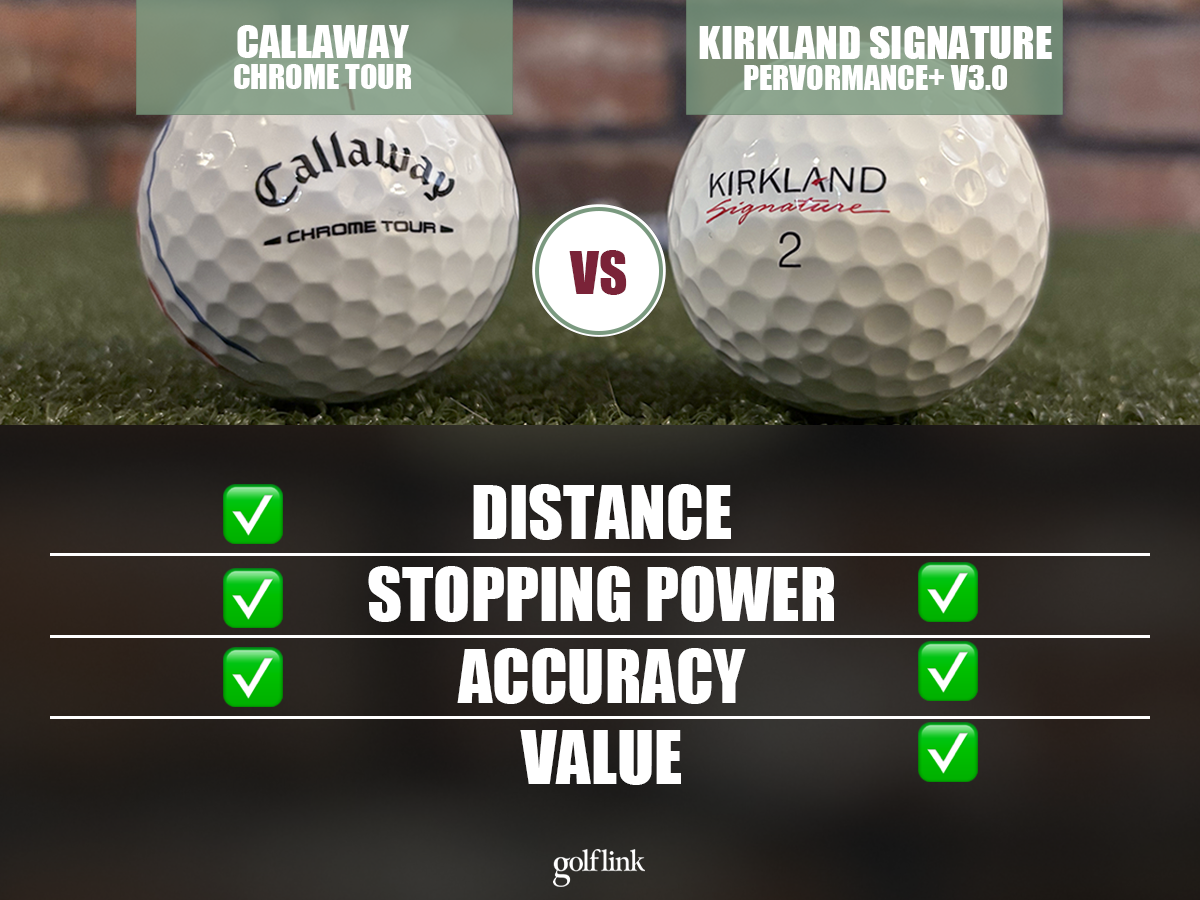
Spin, launch and apex numbers are more or less indistinguishable across the board. Overall, consistency is effectively a tie. When you pare it all down, the difference between the two balls in our testing is a few yards of distance with the full swing clubs, and about a foot of stopping power from 50 yards.
How much are those gains worth to you?
See the complete data from our test of the Callaway Chrome Tour and the Kirkland Signature Performance+ golf balls.
Which Ball Is For You?
Kirkland Signature Performance+ churns out about 95% the performance of Callaway Chrome Tour for about 35% of the price.
If you’re debating between the two, it really comes down to whether or not you want to pay a premium price for that last extra bit of performance.
If you don’t want to make distance sacrifices with full-swing shots, and you want every inch of stopping power from your wedge game that you can get, and you’re OK with paying a premium price, then the Callaway Chrome Tour is an easy choice.
If you can’t stomach paying $58 for a dozen golf balls, and want an alternative that still performs very well, and even nearly identically in some categories, with some minor distance sacrifices, then the Kirkland Signature Performance+ is your best choice.