How We Test Golf Balls
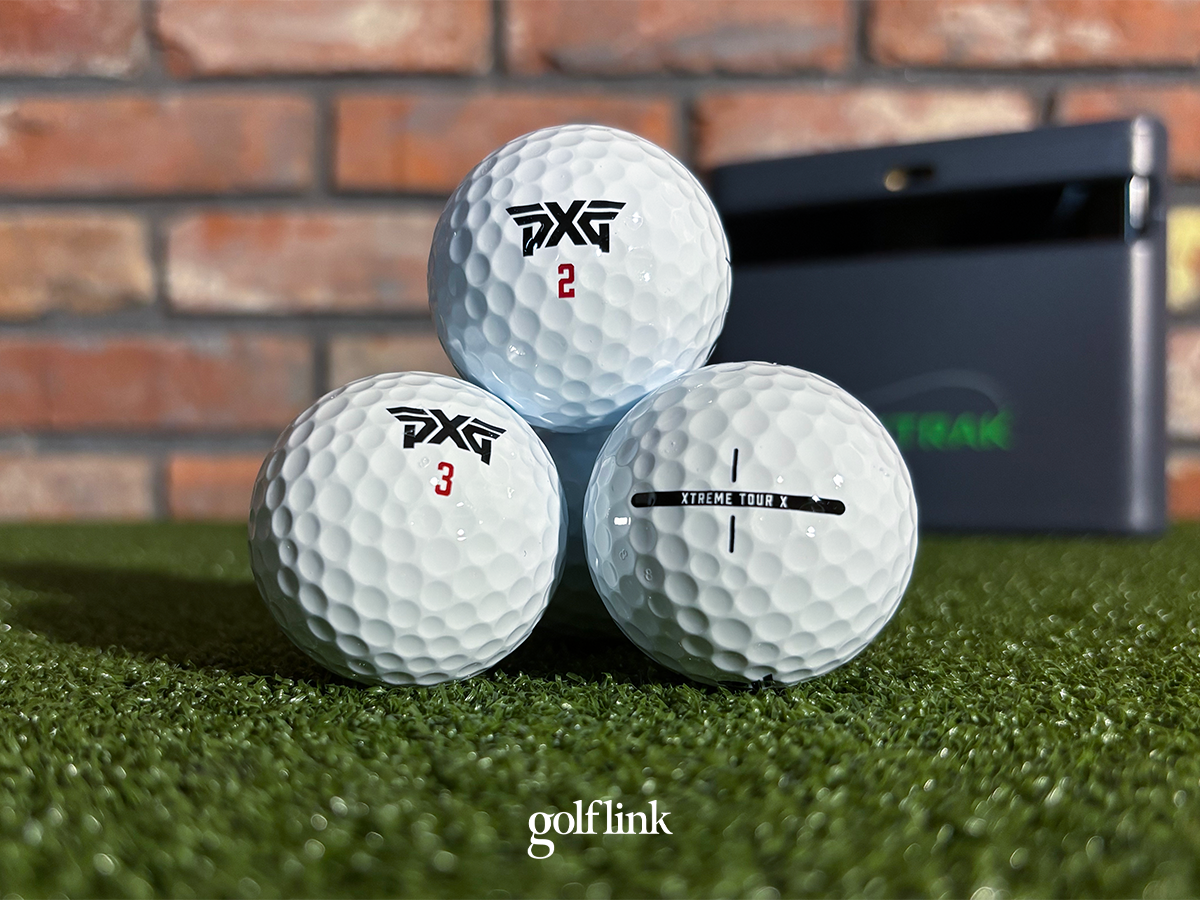
Our goal with golf ball testing is simple: give everyday golfers clear, trustworthy, and digestible data that helps them choose a better ball for their game.
Here’s exactly how we test golf balls, including what data we collect, how we convert that data into easy-to-understand scores, and the limitations of our testing.
Why We Use Humans: Our Golf Ball Testing Philosophy
Robot testing removes variability, but golf is a game of variability.
Our testing replicates how most golfers actually play, not how a robot swings or elite tour players perform under perfectly repeatable conditions. We use human testing because it allows us to evaluate golf balls the way most players actually experience them on the course.
This approach helps us identify:
- Differences golfers can actually feel
- Ball behaviors that appear under real swing conditions
- Performance tradeoffs that show up over multiple shots, not perfect swings
Robot testing is extremely effective at isolating small, repeatable performance differences between golf balls. But those differences are most relevant to a very narrow slice of golfers. I spoke with a representative from Titleist about our ball testing, and he was skeptical about our method. He argued that in their testing, even the world's best ball-strikers can't come close to replicating the consistency of a robot. He was trying to make the point that you need bulletproof repeatability for ball testing, but he actually proved my point: if the world's best ball-strikers can't glean minor differences between two balls, then why should recreational players care about those differences?
Roughly 1% of the 28.1 million Americans who play golf each year play to a 5.0 handicap or better, meaning the overwhelming majority of players simply won’t see those minute differences show up on the course. Our testing identifies the performance attributes that you can expect to show up on the course.
Our human testing is designed to strike a balance. We maintain tight standards around swing speed, ball speed, club delivery (face and path), and launch conditions, while still allowing for the natural swing-to-swing variance that defines how most golfers actually play. The result is testing that’s controlled and repeatable, yet reflective of how 5–25 handicap golfers experience golf balls in the real world.
Clubs and Shots We Test
Each golf ball is tested using three shots that represent the majority of real-world golf performance:
- Driver
- 7-Iron
- 50-Yard Shot
Testing these three shots allows us to evaluate distance, accuracy, and stopping power from tee to green. We never change the clubs or settings we use for testing, and even standardize tee height so it's exactly the same on every driver swing we test.
See the complete list of every golf ball we've tested.
Building Our 50-Yard Test
Simply hitting shots that travel 50 yards with a variety of golf balls would require different swing inputs (speed, for example) for each ball, due to differences in ball speed and launch characteristics. That would introduce variability we want to attribute to the golf ball itself, not the swing.
Instead, we worked backwards to identify the swing and delivery inputs that consistently produced a 50-yard shot. We then built performance bands based on those inputs to standardize our 50-yard shot test across all balls. Because we standardized the inputs, not the total distance, some balls traveled more or less than 50 yards.
Our goal was not to create a “perfect” wedge swing, but one that reflects how golfers actually hit scoring shots. We look at spin, apex, and descent angle to evaluate control and stopping power.
Shot Collection Process
To ensure fair, repeatable results, we test every golf ball under tightly controlled swing and impact conditions.
Our shot-quality parameters are based largely on LPGA Tour averages, which closely mirrors the swing speeds, launch conditions, and ball flights of skilled amateur golfers. This allows us to isolate ball performance rather than test how a ball behaves at tour-level or robot-level swing speeds.
We use swing‑speed bands, but when ball speed is high enough to mathematically guarantee the swing was within that band, we accept the shot. This prevents rejecting perfectly valid shots due to occasional launch monitor under‑reads.
For each club and golf ball:
- Shots must fall within narrow, predefined ranges for speed, impact efficiency, launch, and delivery
- We collect 12 qualifying shots for each club
- From those, we select the eight shots with the most consistent inputs
- All reported averages and scores are calculated using those eight shots
This process minimizes outliers while preserving the natural variability that real golfers experience.
Metrics We Collect
All testing is conducted using the SkyTrak ST Max launch monitor, which allows us to capture high-fidelity ball flight and impact data across driver, iron, and short-game shots.
Depending on the club, we track metrics such as:
- Ball speed and launch angle
- Back spin and side spin
- Carry, roll, and total distance
- Peak height and descent angle
- Dispersion patterns
Rather than publishing large tables of raw numbers, we use this data to create standardized performance scores that make meaningful ball-to-ball comparisons easier for most golfers.
How We Score Golf Balls
To make our results useful for the majority of golfers, not just the few who understand every launch metric, we convert raw data into 1–10 performance scores.
Distance
Distance evaluates how far the ball travels off the tee and is based on total distance with driver.
Stopping Power
Our Stopping Power score measures how quickly and predictably a ball stops on the green.
It combines data from 7-iron and 50-yard shots, including:
- Backspin
- Roll
- Apex
- Descent angle
Wedge Control
Our Wedge Control score indicates how effective a ball performs in our 50-yard wedge shot into greens.
It focuses solely on data collected in our 50-yard test, and includes:
- Backspin
- Roll
- Carry standard deviation (consistency)
- Launch angle
Accuracy
Accuracy measures how consistently a ball flies on line.
Accuracy Score considers:
- Sidespin
- Dispersion patterns with driver and 7-iron
Only shots from our driver and 7-iron testing that have a recorded swing path of +/- 3.0° or less and a face-to-path relationship of +/- 1.5° or less are used to calculate our accuracy score. Each ball has a minimum of two qualifying driver shots and two qualifying 7-iron shots to recieve an accuracy score.
Because sidespin and distance from center is based more on swing dynamics than ball characteristics relative to other areas, it carries less weight in or performance score than the other categories.
Performance Score
The Performance score is a composite rating that combines:
- Distance
- Stopping Power
- Wedge Control
- Accuracy
This score reflects how the ball performs across the entire bag, with equal weight given to Distance, Stopping Power, and Wedge Control, and less weight given to Accuracy.
Value Score
Value balances performance and price.
Our Value Score considers:
- Performance score
- Price per dozen (based on the lowest available price per dozen, including bulk prices for purchasing two dozen or more)
Total Score
Our Total Score combines:
- Performance
- Value
Performance is weighted more heavily, ensuring the highest-rated balls are strong performers and that cheap options don’t get inflated scores based on price alone.
Limitations of Our Testing
No test is perfect, and even with tight input parameters, testing golf balls with humans, not robots, introduces additional variability.
The following are the limitations of our testing:
- Results reflect our testers’ swing profiles, not every possible golfer
- Environmental conditions can never be 100% identical
- Extremely small performance differences between balls may not appear in our data
Our testing is not intended to declare a single “best ball for everyone.”
Instead, it’s designed to help the majority of golfers make more informed purchasing decisions and find the ball, or a selection of balls, that make the most sense to test in their own game.
Our Commitment to Transparency
We may refine our testing protocols as we gather more data. When our process changes, we update our results and explain why.
Our goal isn’t perfection. It’s usefulness, clarity, and honesty.
If you ever have questions about how we test or how to interpret our scores, we encourage you to reach out to GolfLink Editor Nick Heidelberger (nicholas@golflink.com).