32 Types of Golf Shots and When to Hit Them
If you're wondering what all the names of different golf shots mean, here are your answers!

Does golf lingo have your head spinning? That's OK. There are seemingly countless different types of golf shots, and the names of most golf shots aren't exactly self-explanatory. So we've rounded up 32 different golf shots with their names and definitions to help you navigate golf's tricky nomenclature.
To make this list as easy as possible to digest, we’ve broken these shots into two categories. The shots you hit on purpose (when you’re trying to shape it in a specific direction or keep it low, for example), and the shots that are catastrophic misses, like a shank or a slice.
Intentional Golf Shots
Here are the shots you’re trying to hit on the golf course.
Approach Shot
Description: An approach shot is a shot hit from between 50 and 250 yards with the intention of hitting the ball onto the green. Approach shots are often hit with a full swing and taken with irons or hybrids. A tee shot on a par-3, second shot on a par-4, and third shot on a par-5 is an approach shot given that you’re in position.
When to Use It: Any time you’re trying to hit the green
Typical Club: Whichever club provides the right distance and stopping power
Bump and Run
Description: A bump-and-run is a short game shot that rolls (or runs) much farther than it carries in the air. It’s called a bump and run because the shot only requires a “bump” with a lower-lofted club, then runs out towards the target.
When to Use It: Around the green when there are no obstacles between you and the hole
Typical Club: Shorter iron (7-9 iron) or lowest lofted wedge
Bunker Shot
Description: A bunker shot is a shot hit from a sand trap or bunker
When to Use It: When your ball is in a bunker
Typical Club: Sand wedge
Chip
Description: A chip is a shot hit from within 25 yards of the green that rolls out as much or more than it carries in the air.
When to Use It: Within 25 yards of the green
Typical Club: Wedge
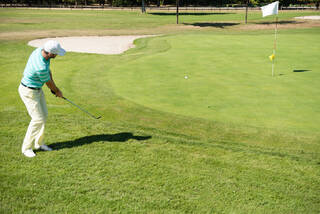
How To Hit A Chip Shot in Golf
Cut
Description: A cut shot is a controlled shot that a player intentionally curves in the direction of their dexterity. A right-handed player hitting a cut would start the ball to the left of where they intended for the ball to finish, and let it curve subtly to the right. A cut can also be referred to as a fade. When a cut is out of control, it becomes a slice.
When to Use It: If it’s your natural shot shape, you can use it on every full swing shot; or simply when the hole location and obstacles between your ball and the hole call for it
Typical Club: Any
Draw
Description: A draw is a controlled shot shape that a player hits in the opposite direction of their dexterity. A right-handed player hitting a draw would start the ball to the right of where they intended for the ball to finish, and let it curve to the left. When a draw is out of control, it becomes a hook.
When to Use It: If it’s your natural shot shape, you can use it on every full swing shot; or simply when the hole location and obstacles between your ball and the hole call for it
Typical Club: Any

How to Hit a Draw in 3 Steps
Drive
Description: A drive is a player’s tee shot on a par-4 or par-5 hole. A good drive advances the ball as far as safely possible and leaves a clear path from the ball to the hole.
When to Use It: On any tee box of a par-4 and par-5 hole
Typical Club: Driver or the longest club you’re confident you can strike well

How to Hit Your Driver: Learn to Hit Straighter, Longer Drives
Fade
Description: Fade is a more common term for a cut shot, where a player intentionally hits a controlled shot that curves in the direction of their dexterity. For a right-handed player, a fade starts to the left and subtly curves from left to right.
When to Use It: If it’s your natural shot shape, you can use it on every full swing shot; or simply when the hole location and obstacles between your ball and the hole call for it
Typical Club: Any
Fairway Finder
Description: A fairway finder is a casual term for a drive or tee shot that is hit with the primary goal of hitting the fairway, even if some distance is sacrificed for more precision.
When to Use It: On a hole that rewards accuracy more than distance
Typical Club: Either a controlled swing with a driver or the longest club you can hit accurately
Floater
Description: A floater is a shot that is hit high in the air with plenty of hang time, and lands with a steep descent angle. A floater is often a shot that’s hit into a strong wind that seems to hang in the air without advancing very far.
When to Use It: When you need to hit the ball over an obstacle and stop it quickly
Typical Club: Any higher-lofted club
Flop Shot
Description: A flop shot is a short game shot that launches high in the air, and stops quickly when it lands. Flop shots typically do not cover much ground, and are required when a player must carry an obstacle between their ball and the hole, and does not have room to let the ball roll after it lands.
When to Use It: When you need to hit the ball over an obstacle and stop it quickly
Typical Club: Lob wedge

The Secrets to Hitting a Flop Shot
Green Light
Description: A green light shot is a casual term for a situation when a player can take an aggressive line at a flag with little to no risk.
When to Use It: When there is reward with little to no risk
Typical Club: Whichever club goes the distance required
Hybrid Chip
Description: A hybrid chip is a chip shot from near the green that a player hits with a hybrid club with a similar technique to a putting stroke. A hybrid chip can be used when a player wants to hit a controlled shot that stays on the ground and rolls up to the hole, but has too much fringe or rough to use a putter. Chipping with a hybrid will skip the ball through the first portion of the turf before rolling out.
When to Use It: When you need to get through some rough or fringe then let the ball roll to the hole
Typical Club: Hybrid
Lag Putt
Description: A lag putt is a long-distance putt, 20-feet or more, that finishes close to the hole and leaves only a tap-in.
When to Use It: Long putts when a 2-putt is a success
Typical Club: Putter

How to Lag Putt With Confidence and Reduce 3-Putts
Lay Up
Description: A lay up is a shot that a player plays to a specific distance or intentionally hits short of a specific obstacle in an effort to reduce the possibility of trouble or penalty strokes.
When to Use It: When there is too much risk or too low of a chance of success to attempt to reach the green
Typical Club: Your longest club that cannot possibly reach the trouble
Low-Spinner
Description: A low spinner is a popular short-game shot that launches low and has high spin. After a low-spinner lands on the green, it stops quickly.
When to Use It: Around the green
Typical Club: Lob wedge
Pitch
Description: A pitch shot is a short game shot from inside of 50 yards that flies farther than it rolls.
When to Use It: Inside of 50 yards
Typical Club: Wedge
Punch Shot
Description: A punch shot is a shot hit with a partial swing and lower-lofted club in an effort to advance the ball a controlled distance to a specific position. A punch shot has a lower trajectory than a full swing shot and will roll out after it lands.
When to Use It: When wind could negatively impact a shot that flies too high
Typical Club: Long iron
Punch Out
Description: A punch out is a punch shot that a player hits from a spot of trouble. If a player’s ball is in thick rough or fescue, or there is a branch, bush or other obstacle that prevents a player from taking a full swing at the hole, the player likely needs to punch out to get back into position.
When to Use It: When you need to get back into play from under trees and keep the ball low
Typical Club: Long iron
Putt
Description: A putt is a stroke taken with a putter that rolls the entire way. Any stroke taken from the putting green is technically considered a putt, and players often putt from just off the putting green when there are no obstacles between their ball and the hole.
When to Use It: On the putting green
Typical Club: Putter

How to Putt in Golf: A Complete Guide From Stance to Speed
Stinger
Description: A stinger is a shot that’s intentionally hit on a low trajectory and rolls out a long way. Stingers help players keep the ball out of the wind and can more control to some difficult shots.
When to Use It: When wind could hurt a shot that flies too high and maximum roll out will help, not hurt
Typical Club: Long iron or driving iron
Two-Hop-And-Stopper
Description: A two-hop-and-stopper is a term to describe a short game shot that, after landing on the green, hops twice then quickly stops. A low spinner is often a two-hop-and-stopper.
When to Use It: Around the green
Typical Club: Lob wedge
Accidental Golf Shots
These are the results of the shots you didn’t quite execute the way you wanted to out there.
Block
What is it: A block is a type of miss-hit that happens when you miss in the direction of your dexterity (to the right for a right-handed player) and the ball flies straight with little if any curve. A block can also be referred to as a push.
How to Avoid It: Get your clubface more square at impact
Chunk
What is it: A chunk is a type of mis-hit that occurs when the player hits the ground before hitting the ball, resulting in a severe loss of distance and usually a large divot.
How to Avoid It: Fix your swing plane
Hook
What is it: A hook is a mis-hit that curves severely in the opposite direction of a player’s dexterity. For a right-handed player, a hook is an out-of-control shot that curves to the left.
A regular hook shot may start to the right for a right-handed player before hooking left, while a straight hook starts at the target line then hooks, and a pull-hook starts to the left of the target, then hooks even further left.
How to Avoid It: Stop over-rotating hands
Pull
What is it: A pull is a mis-hit shot that travels on a relatively straight line in the opposite direction of a player’s dexterity. For a right-handed player, a pull shot flies to the left and has little to no curve.
How to Avoid It: Start by improving your backswing
Push
What is it: A push shot is a mis-hit that flies on a fairly straight line in the direction of a player’s dexterity. A right-handed player who hits a push will miss their target to the right. Push is another term for block.
How to Avoid It: Get your clubface more square at impact
Shank
What is it: A shank is a mis-hit in which the player strikes the ball off the hosel of the golf club rather than the club face. Shanks typically fly low and at about a 45-degree angle in the direction of the player’s dexterity (to the right for a right-handed player).
How to Avoid It: Work on squaring the clubface at impact
Skull
What is it: Skull is a casual term to describe when the club strikes the equator of the ball, causing it to fly significantly lower and farther than the player intended. Skulls are typically associated with short-game shots but can happen in any situation. Hitting the ball thin is synonymous with a skull.
How to Avoid It: Hit the ball, then the ground
Slice
What is it: A slice is a mis-hit that curves out of control in the direction of a player’s dexterity. For a right-handed golfer, a slice curves severely to the right. A slice can start to the left then slice to the right, start straight then slice (straight slice) or start right and slice even farther to the right (push slice).
How to Avoid It: Square your clubface at impact

What Causes a Golf Slice and the Easiest Way to Fix It
Thin Shot
What is it: Synonymous with a skulled shot, a thin shot describes a ball that is struck on the equator and flies much farther and lower than intended.
How to Avoid It: Hit the ball then the ground
Top
What is it: A topped shot is a shot that is struck on the top-half of the ball. Topped shots often pop up into the air then bounce and roll forward a short distance.
How to Avoid It: Maintain a consistent bend through impact