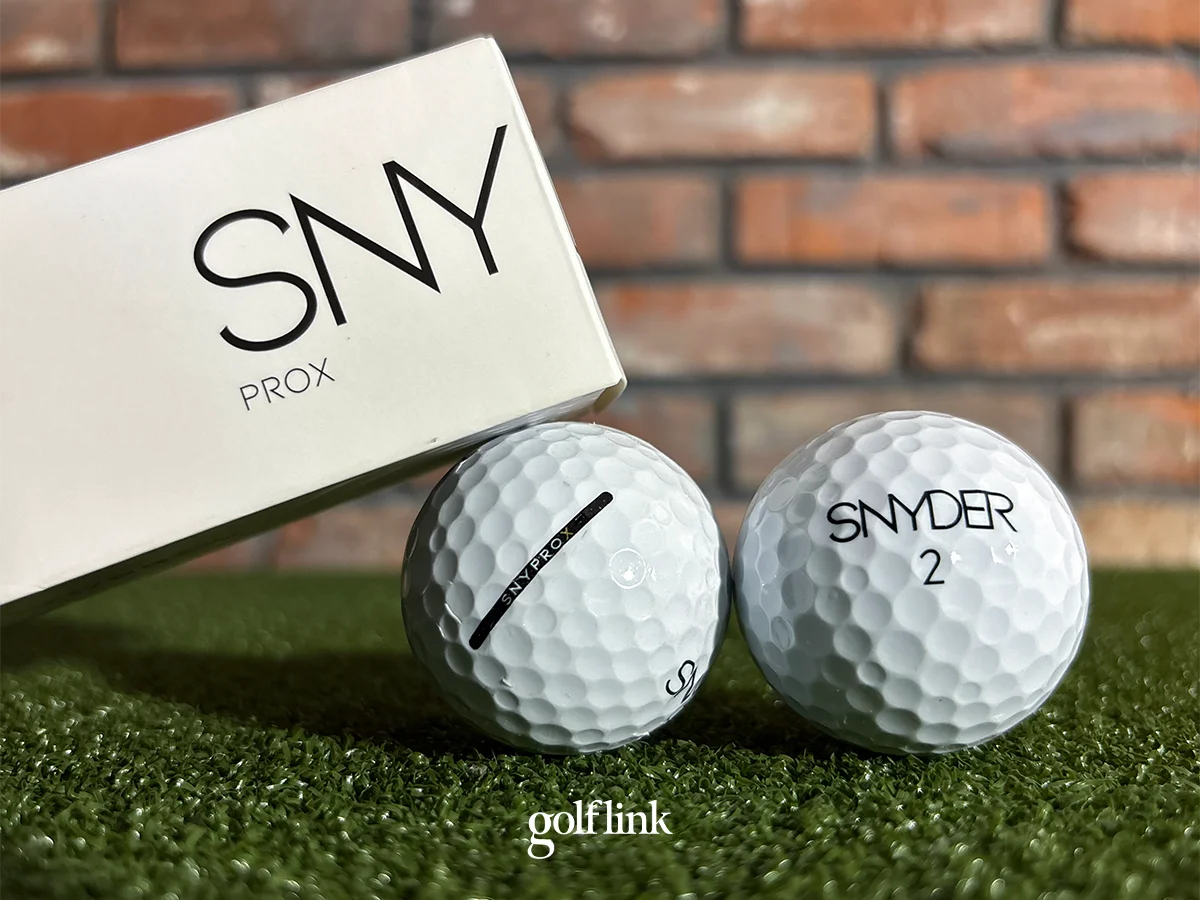

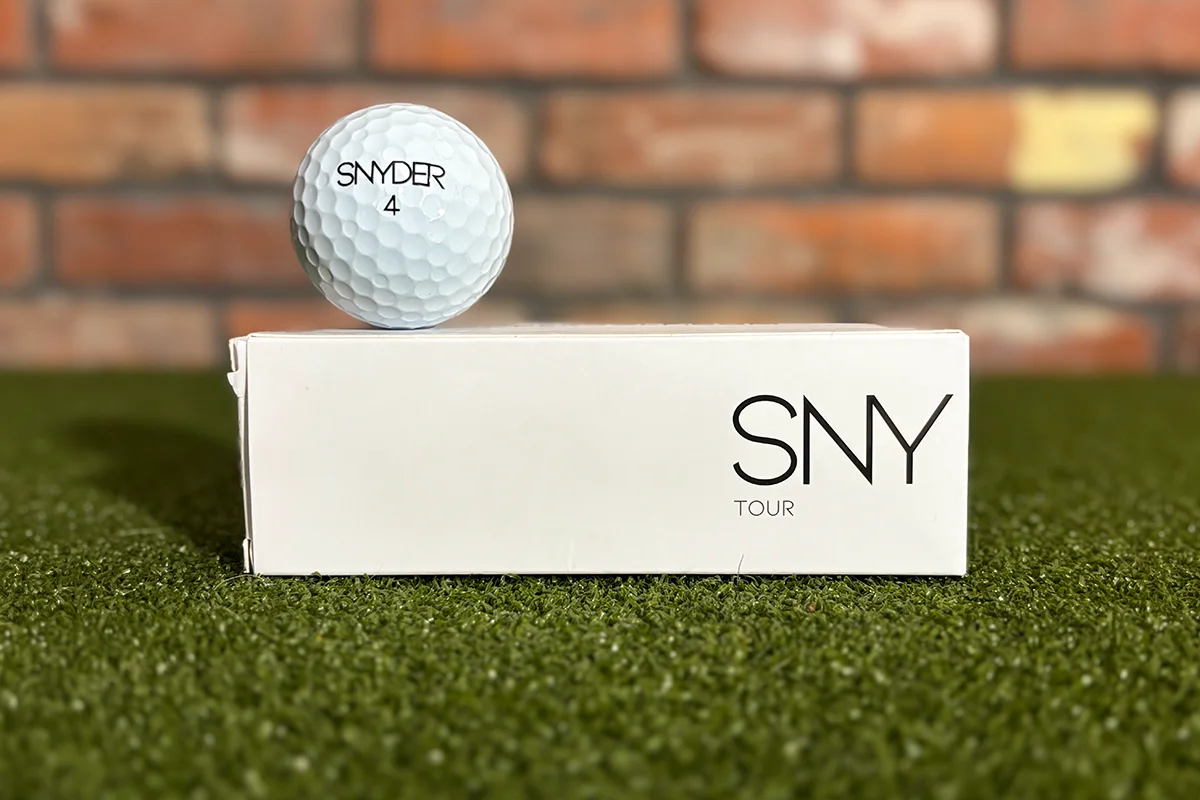
Snyder Tour sits in the middle of the up-and-coming German DTC brand's six-ball lineup. It’s a three-piece urethane ball aimed at players who want a softer-feeling, AVX-style penetrating ballflight without Titleist’s premium price tag. It’s just $28 a dozen with no bulk commitment – when it’s in stock – a price that will capture the attention of a lot of players.
We ran Snyder Tour through our full standardized golf ball testing, and the results make an interesting case. Compelling performance at a price most tour balls can't touch, with some real weaknesses that may make you think twice.
Here's the full scoop.
How We Tested the Snyder Tour
We put the Snyder Tour through our published golf ball testing protocols using the SkyTrak ST Max launch monitor. That means human swings under strict bands for swing speed, impact quality, and delivery dynamics.
Because we use human swings, not robots, our data reflects the performance differences you can actually expect to see on the course, not microscopic variances under perfect conditions. We use strict benchmarks for swing speed, shot quality, and delivery dynamics to keep results as consistent as possible.
Individual results will vary, but the patterns we see across dozens of shots are meaningful.
Learn more about how we test golf balls and see the complete list of every golf ball we've tested. You can also check out our complete Snyder Tour test data here.
Snyder Tour Specs, Pricing & Performance
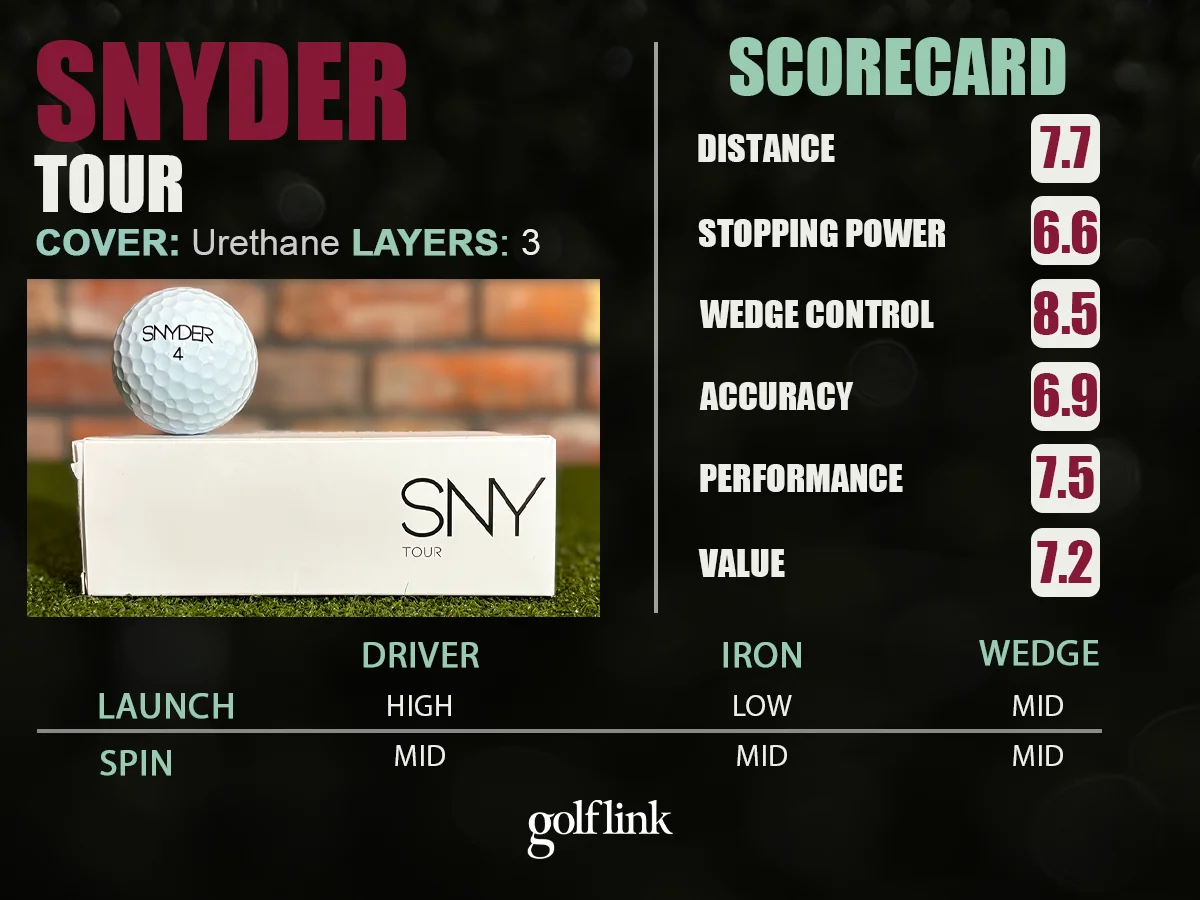
Snyder Tour occupies the same spot in the lineup as established DTC stalwarts Maxfli Tour S and Vice Pro Air – meaning it’s intended to be the softer, lower-flying urethane alternative to each brand’s flagship and X-balls.
In our test, Snyder Tour showed a mid-spin, high-launch ball flight with driver, mid-spin and low-launch with 7-iron, and mid-spin, mid-launch from 50 yards.
Shot | Spin | Launch |
Driver | Mid | High |
7-Iron | Mid | Low |
50-Yard Shot | Mid | Mid |
Shot
Spin
Launch
Driver
Mid
High
7-Iron
Mid
Low
50-Yard Shot
Mid
Mid
Distance: 7.7/10
Snyder Tour finished 18th of 43 balls in our distance test — a solid result for a ball that is literally half the price of today’s premium tour balls. It totaled 242.0 yards on average in our driver test, which is about a foot longer than the average output of our entire 43-ball field.
From a sheer distance standpoint, Snyder Tour was within about a foot of balls like Titleist Pro V1x, Callaway Chrome Tour Triple Diamond, TaylorMade TP5x and Callaway Chrome Tour X. That’s not bad company to keep, especially when you look at the contrasting prices.
But those balls are built to excel closer to the green rather than off the tee. So the question is, can Snyder Tour keep up with them tee to green?
Category | Snyder Tour |
Ball Speed (mph) | 136.1 |
Carry (yds) | 222.0 |
Total Distance (yds) | 242.0 |
Launch Angle | 15.1° |
Distance Score | 7.7 |
Stopping Power: 6.6/10
The truth is Snyder Tour struggled to stop quickly on the green in our iron test, and Stopping Power proved to be its weakest attribute.
The penetrating ball flight design doesn’t lend itself to stopping quickly, and it showed. Snyder Tour was in the bottom-five of 43-balls in peak height (21.6 yards) in our 7-iron test, which meant a shallow descent angle (39.3°). However, its spin rate was around the middle of the pack, which kept it from rolling out uncontrollably.
If you already hit the ball high and are seeking a more penetrating ball flight without sacrificing too much spin, Snyder Tour could be just what the doctor ordered. But if you want to throw darts that stick, there are better balls for that.
Category | Snyder Tour |
7-Iron Spin (RPM) | 4,321 |
7-Iron Roll (yds) | 11.9 |
Descent Angle | 39.3° |
Stopping Power Score | 6.6 |
Wedge Control: 8.5/10
Snyder Tour turned in a compelling performance in our 50-yard wedge test. With 6,624 RPM of spin, a 31.6-degree launch, and just 2.6 yards of rollout, it stopped within one foot of 18 other balls in our test.
Translation? This backs up Snyder’s ethos that you can get virtually identical performance for half the price of a premium tour ball.
The five fastest-stopping balls in our 50-yard wedge test rolled out about one yard less on average, but after that, performance becomes bunched, and indistinguishable from one ball to the next until you get to about the bottom-third of the field.
The urethane cover is doing its job around the greens. Whatever ground Snyder Tour gave up on approach shots, it makes most of it back around the green.
Category | Snyder Tour |
50-Yard Spin (RPM) | 6,624 |
50-Yard Launch | 31.6° |
Wedge Control Score | 8.5 |
Accuracy: 6.9/10
Snyder Tour finished 33rd of 43 balls in accuracy, which supports Snyder’s claim that the Tour allows players to “shape iron shots when needed”. Driver dispersion averaged 3.3 yards offline, actually one of the tighter driver numbers we saw. Iron accuracy came in at 7.0 yards offline with 199.5 RPM of sidespin.
Despite the tight driver dispersion, the overall accuracy score reflects the sidespin more than the raw offline number. It's the second category, alongside stopping power, where Snyder Tour trails the tour-ball pricing tier, if accuracy is a priority for your game.
Category | Snyder Tour |
Driver Offline (yds) | 3.3 |
Driver Sidespin (RPM) | 224.3 |
7-Iron Sidespin (RPM) | 199.5 |
Accuracy Score | 6.9 |
Value: 7.2/10
At $33 a dozen in bulk — the price that Snyder Tour cost when we scored it — it cost roughly 40 percent less than the legacy balls it’s competing against. The value score of 7.2 reflected a ball that delivers real performance for the price, with tradeoffs in stopping power and accuracy worth considering.
Since then, Snyder has permanently dropped the price to $28 a dozen with no bulk minimum required. We didn’t recalculate the value score, since one price change shouldn't ripple through the rest of our 43-ball comparison. But at this new price, Snyder Tour is an even better deal than the 7.2 suggests.
Whether that math works for you depends on where your actually need your ball to help your game. If it's off the tee, Snyder Tour is a legitimate budget alternative to a $57 ball. If it's stopping approach shots on firm greens, the savings come with a cost.
Who is Snyder Tour For?
Snyder Tour is for the player who wants tour-ball distance without tour-ball pricing, and who isn't chasing maximum stopping power or the tightest possible dispersion. Our test found competitive distance and wedge control performance at a price point most other balls can't compete with.
The stopping power and accuracy results are the honest caveat. If your misses are already costing you strokes off the tee or on approach, this ball isn’t going to fix that. But for the mid-to-low handicapper who hits it reasonably well already and wants to cut their ball cost in half, Snyder Tour makes a compelling case.