Pro V1 vs Kirkland Signature Golf Balls: What Our Test Revealed
What's the difference between budget and premium? Our head-to-head testing found answers.
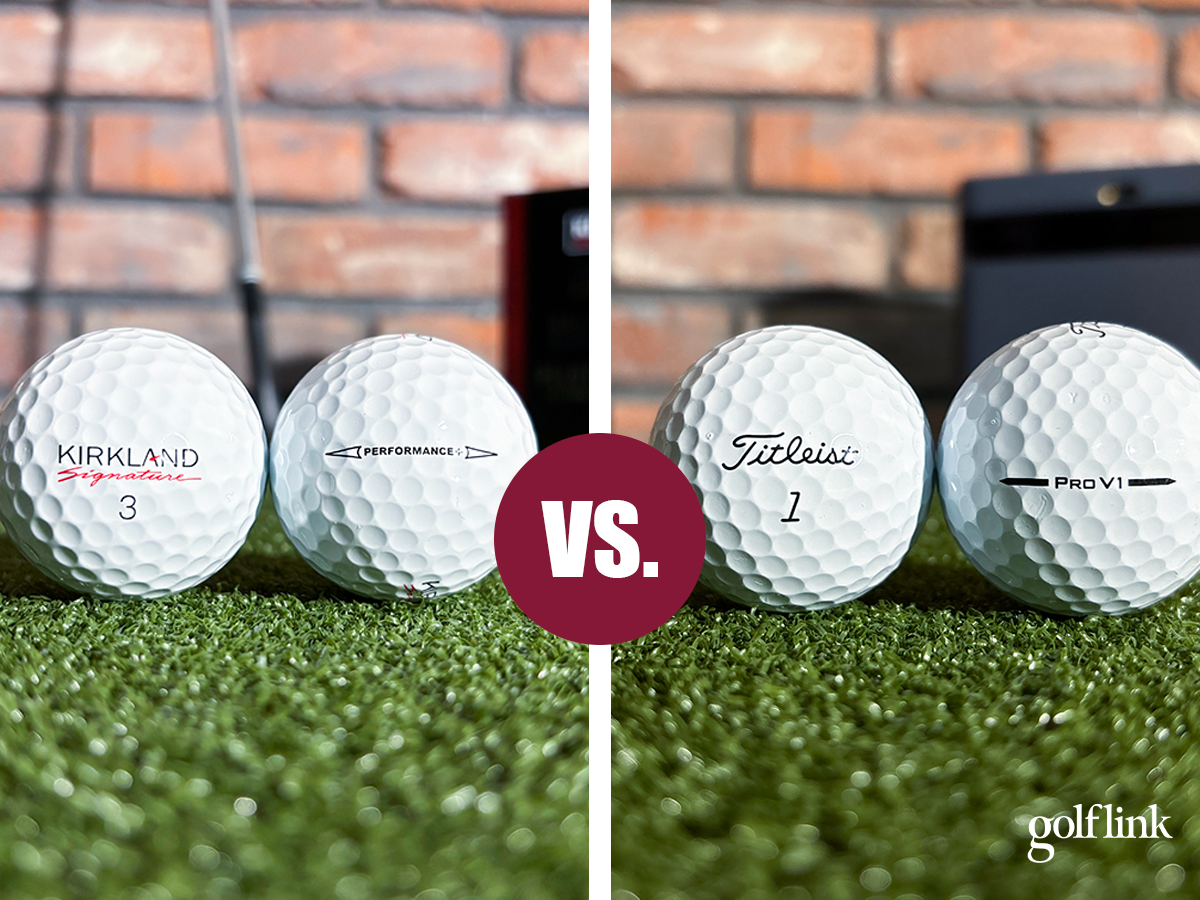
On the surface, Titleist Pro V1 and Kirkland Signature Performance+ v3.0 are almost identical. They’re both three-piece, urethane-covered golf balls built for premium performance.
But you already know that’s not the whole story.
One is among the most-played balls on professional tours worldwide. The other? You buy them 24 at a time from one of the world’s biggest wholesale warehouses. A dozen Pro V1s costs $58 in 2026. Kirkland Signature only charges $21 per dozen after you do the mental math to convert the bulk price.
The real question is: other than $37 per dozen, what actually separates two of the most popular golf balls on planet earth?
We tested them both. Here’s how Titleist Pro V1 and Kirkland Signature Performance+ v3.0 (which we also like to simply refer to as K-Sig) compare in a true head-to-head.
How We Tested Pro V1 & Kirkland Signature Golf Balls
We tested the Titleist Pro V1 and K-Sig golf balls using our standardized golf ball testing protocol on the SkyTrak ST Max launch monitor.
Because we use human swings, not robots, our data reflects the performance differences you can actually expect to see on the course, not microscopic variances under perfect conditions.
We use strict benchmarks for swing speed and ball speed, delivery dynamics (face and path), and shot quality to keep results as consistent as possible.
Individual results will vary, but the patterns we see across dozens of shots are meaningful.
Learn more about how we test golf balls and see the complete list of every golf ball we’ve tested.
You can also check out our full Titleist Pro V1 test data here and our Kirkland Signature Performance+ v3.0 test data here.
Kirkland Signature vs. Pro V1 Overview
There isn’t much on the surface that distinguishes Pro V1 from Kirkland Signature. But as they say, the devil is in the details, and nobody has a stronger reputation for excruciating over the details than Titleist (at least not when it comes to golf balls).
|
Titleist Pro V1 |
Kirkland Signature |
|
|
Cover |
Urethane |
Urethane |
|
Layers |
3 |
3 |
|
OEM Description |
Mid trajectory; very low long game spin; high short game spin |
High performance; high velocity; controlled spin; consistent flight; superior greenside control |
|
Price |
$58 / dozen |
$42 / 2 dozen |
Ball Flight Comparison
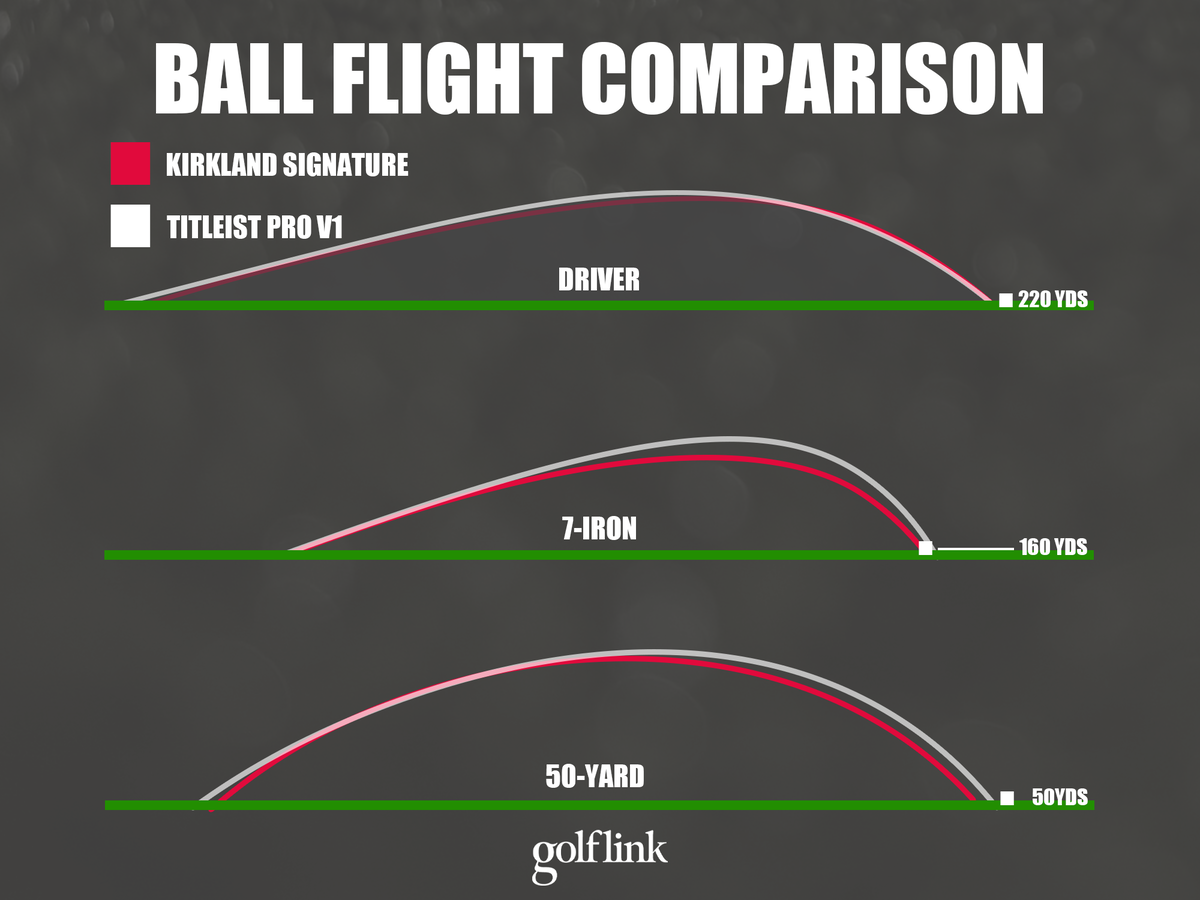
We tested the Pro V1 and Kirkland Signature golf balls with driver, 7-iron and a 50-yard wedge shot.
Compared to the database of golf balls we’ve tested, which was over two dozen at the time of this publication, it’s fair to profile both balls as higher-spin and mid-launch.
Pro V1 produced noticeably more 7-iron spin than Kirkland Signature, which, coupled with a steeper descent angle, helped it dominate the stopping power category.
Here’s a look at the launch and spin profile of each ball across our testing.
| Titleist Pro V1 | Kirkalnd Signature v3.0 | |
| Driver Spin | High | High |
| 7-Iron Spin | High | Mid |
| Wedge Spin | Mid | High |
| Driver Launch | Mid | Mid |
| 7-Iron Launch | High | Mid |
| Wedge Launch | Mid | Low |
Distance
If you’re looking for a winner between these two balls, you won’t find it in the distance category.
In fact, Kirkland Signature and Pro V1 churned out nearly identical numbers across the board in our driver test. Carry and total distances were both within one yard of each other. Launch angles were within 0.2 degrees of each other. The biggest gap, if you can call it that, in our driver test was the extra 118 RPM of backspin that the Kirkland Signature displayed.
| Category | Pro V1 | K-Sig |
| Driver Carry (Yds) | 217.3 | 218.0 |
| Driver Total (Yds) | 237.6 | 238.0 |
| Distance Score | 6.4 | 6.5 |
Stopping Power
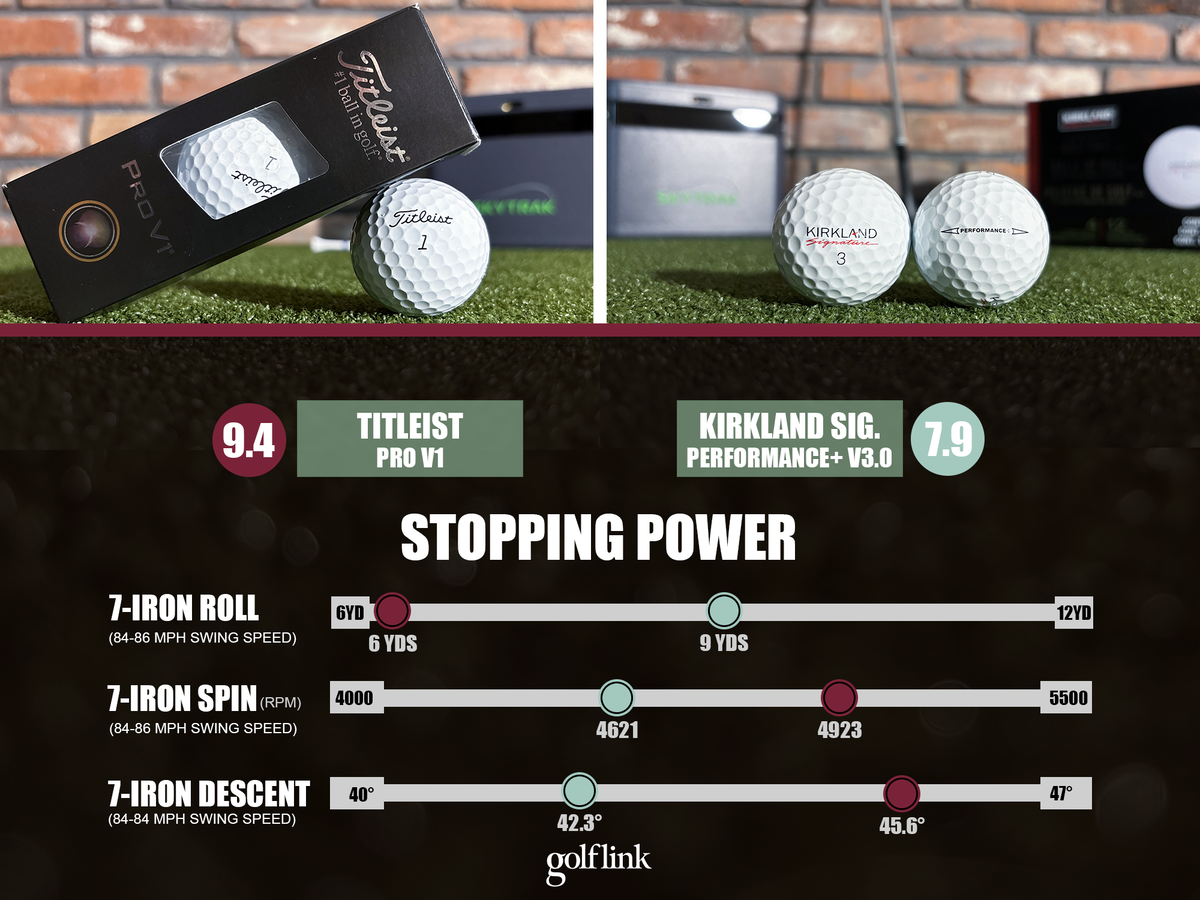
Our stopping power test gave us two clean takeaways.
First, Titleist Pro V1 easily wins this category against K-Sig.
Secondly, however, Kirkland Signature was not bad in stopping power all things considered (and by that, I specifically mean that $21/dozen price).
Pro V1 produced more spin, a steeper descent angle and less roll than not only K-Sig, but virtually every other ball we’ve tested.
This isn’t exactly earth-shattering news. The players who make a living stopping the golf ball near the hole pick Pro V1 more than any other ball (except perhaps its sibling, Pro V1x). It’s the gold standard of golf balls for a reason (several, actually) and stopping power is a big one.
The Kirkland Signature ball might not be competitive with Pro V1 in this category, but it held its own against the field. It produced better-than-average 7-iron spin and descent angle with a mid ball flight.
In other words, you might not get world class stopping power from the K-Sig, but it won’t hurt you in that department, either.
| Category | Pro V1 | K-Sig |
| 7-Iron Roll (Yds) | 6.4 | 9.3 |
| 7-Iron Spin (RPM) | 4923 | 4621 |
| 7-Iron Descent Angle | 45.8° | 42.2° |
| Stopping Power Score | 9.4 | 7.9 |
Wedge Control
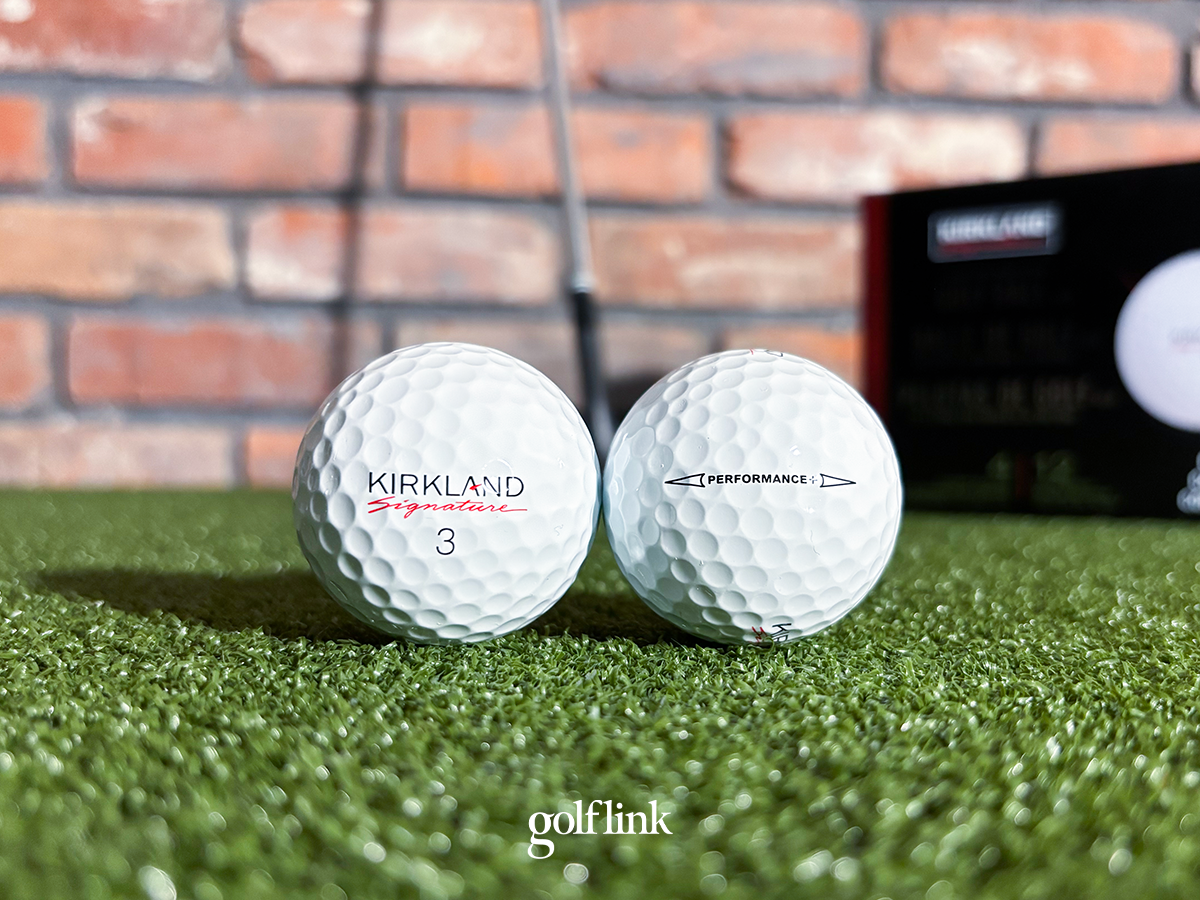
If you’re looking for an excuse to play the budget ball instead of paying top-dollar to play what the pros play, check out the K-Sig Wedge Control score.
Our Wedge Control score factors in launch angle, spin, roll, and carry distance consistency, and Kirkland Signature shined. K-Sig proved it’s a premium ball into and around the greens with higher spin rates in our wedge test than Pro V1 and a tighter carry distance standard deviation.
Of course, Pro V1 was equally excellent across the 50-yard test, but that’s become the expectation for Titlest’s flagship ball.
| Category | Pro V1 | K-Sig |
| 50-Yard Launch | 32.6° | 31.4° |
| 50-Yard Spin (RPM) | 6798 | 7095 |
| 50-Yard Roll (Yds) | 2.0 | 2.4 |
| Wedge Control Score | 8.8 | 8.9 |
Accuracy
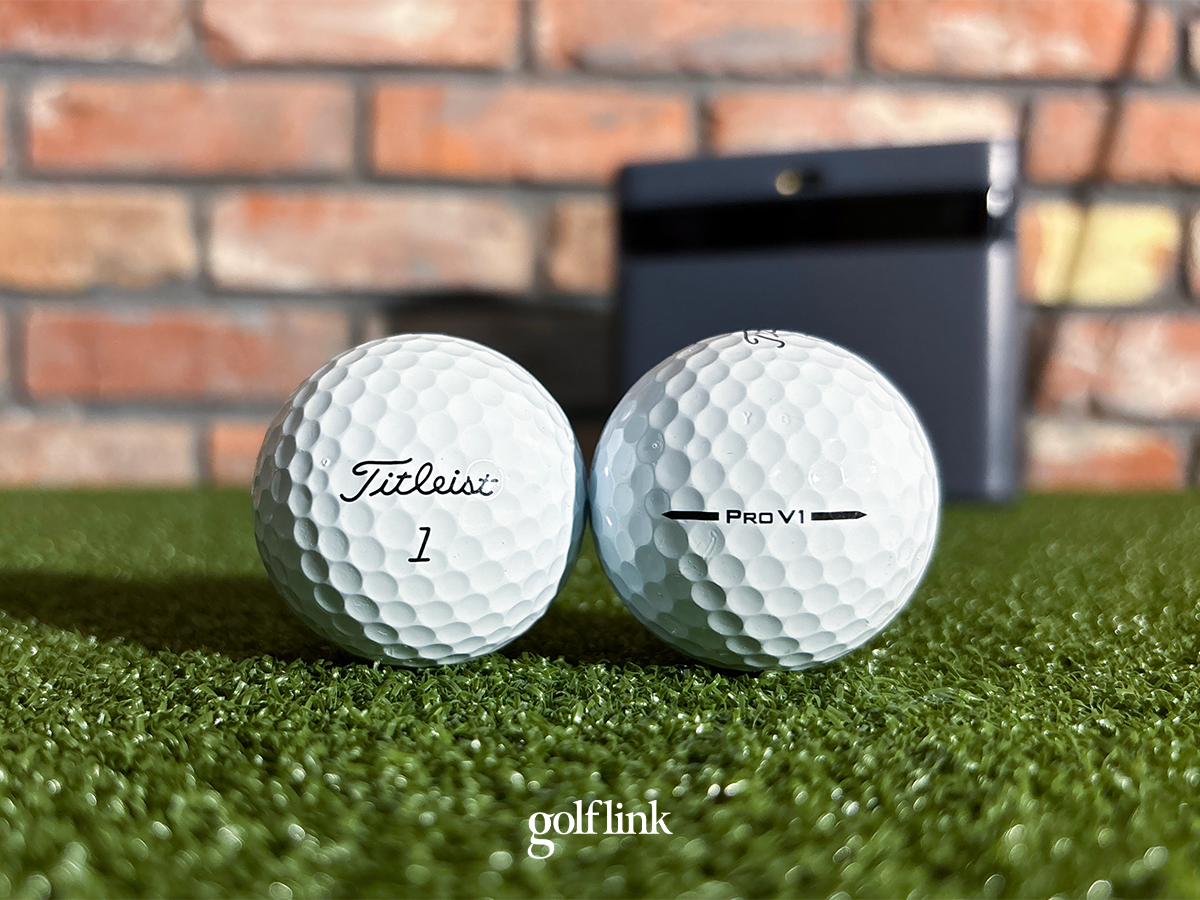
Pro V1 outperformed the Kirkland Signature golf ball in our accuracy category, thanks to better sidespin control.
Both balls are workable for players who prefer to execute a specific shot shape, the K-Sig was simply prone to higher sidespin numbers in our testing.
| Category | Pro V1 | K-Sig |
| Driver Sidespin (RPM) | 246 | 280 |
| Driver Offline (Yds) | 9.0 | 3.5 |
| 7-Iron Sidespin (RPM) | 64 | 117 |
| 7-Iron Offline (Yds) | 6.5 | 4.7 |
| Accuracy Score | 7.4 | 6.6 |
Overall Performance
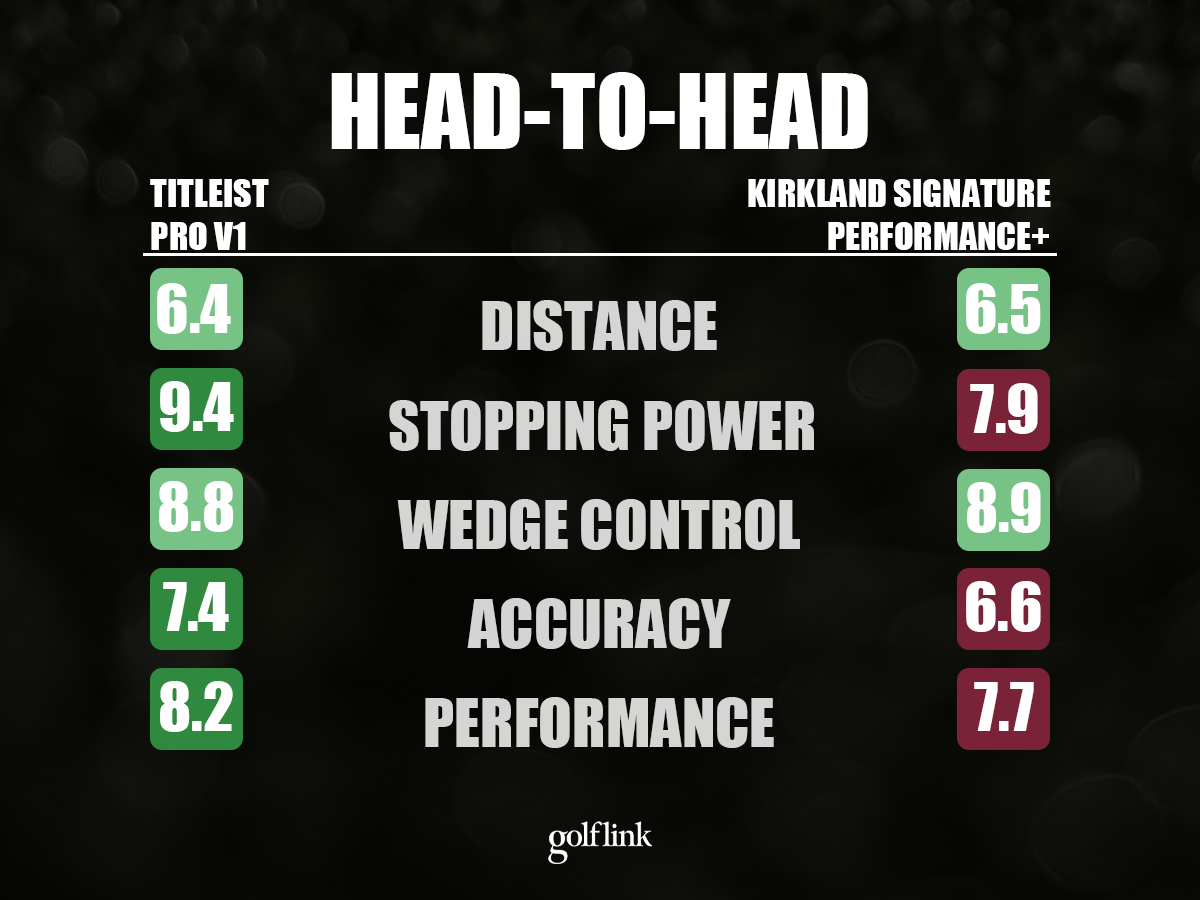
We combine our Distance, Stopping Power, Wedge Control and Accuracy scores to get each ball’s overall Performance score. When you add it all up, Pro V1 is the head-to-head winner with an overall Performance score of 8.2 against K-Sig’s 7.7 score.
The fact that Pro V1 performs better than Kirkland Signature golf balls shouldn’t be shocking information. The useful takeaway is where Pro V1 is better, where K-Sig holds its own, and whether those performance gaps justify the massive price gap between the two balls.
| Category | Pro V1 | K-Sig |
| Distance | 6.4 | 6.5 |
| Stopping Power | 9.4 | 7.9 |
| Wedge Control | 8.8 | 8.9 |
| Accuracy | 7.4 | 6.6 |
| Overall Performance | 8.2 | 7.7 |
Which Ball Should You Choose?
So, which ball should you play? The takeaway boils down to this:
- If you want premium performance without any sacrifices, Pro V1 is the best ball for you;
- If you want premium performance with some sacrifices (average stopping power instead of elite, acceptable accuracy instead of good) and the best value golf ball out there, Kirkland Signature is the one for you.
Head-to-head, Pro V1 is the better golf ball. But again, the devil is in the details. In this case it’s the price and how much some meaningful gains in stopping power and better accuracy is worth to you.