Swinging a Golf Club 101 (For Any Level)

Getting started with the game of golf can feel like a monumental task. Specifically, the mechanics of a golf swing and making consistent contact with the ball can be extremely frustrating. But, by building a solid fundamental golf swing -- whether you're just beginning or your swing needs an overhaul -- you will maximize your enjoyment of the game of golf. Understanding the “101” of how to swing a golf club will help you bring your game to the next level.
The golf swing has a few key elements that are all equally important. A proper golf swing begins with a good setup, followed by the backswing, the downswing, and the finish.
By learning the basic fundamentals of each step, you'll build a strong, reliable golf swing that you can further optimize as your game progresses.
PGA Setup
The easiest way to remember the keys to a perfect setup position is to think of the PGA. No, not the tour where the world's best golfers compete. When it comes to your golf setup, Posture, Grip and Alignment are key.
Fundamental Golf Posture
Learning the correct posture and setup at address will save you a lot of the frustration that many golfers endure.
The proper golf posture is an athletic position that includes some knee and hip bend, and great balance. Starting from the ground up, your feet should be shoulder-width apart and knees slightly bent. Next, bend forward from your hips until an imaginary line extending from your sternum intersects the golf ball.
Your shoulders should be level with no rounding or slouching. This gives you the correct feeling of the proper posture throughout your back and legs.
Finally, let your arms hang down naturally as you grip the golf club. You should be able to snugly fit a fist between your belt buckle and the top of your grip. If there is more than a fist's worth of space, bring your arms closer to your body.
Neutral Golf Grip
It’s vitally important to understand how to properly grip a golf club. For right-handed golfers, grip the club in the fingers of your left hand with your heel pad on top of the club as illustrated below.
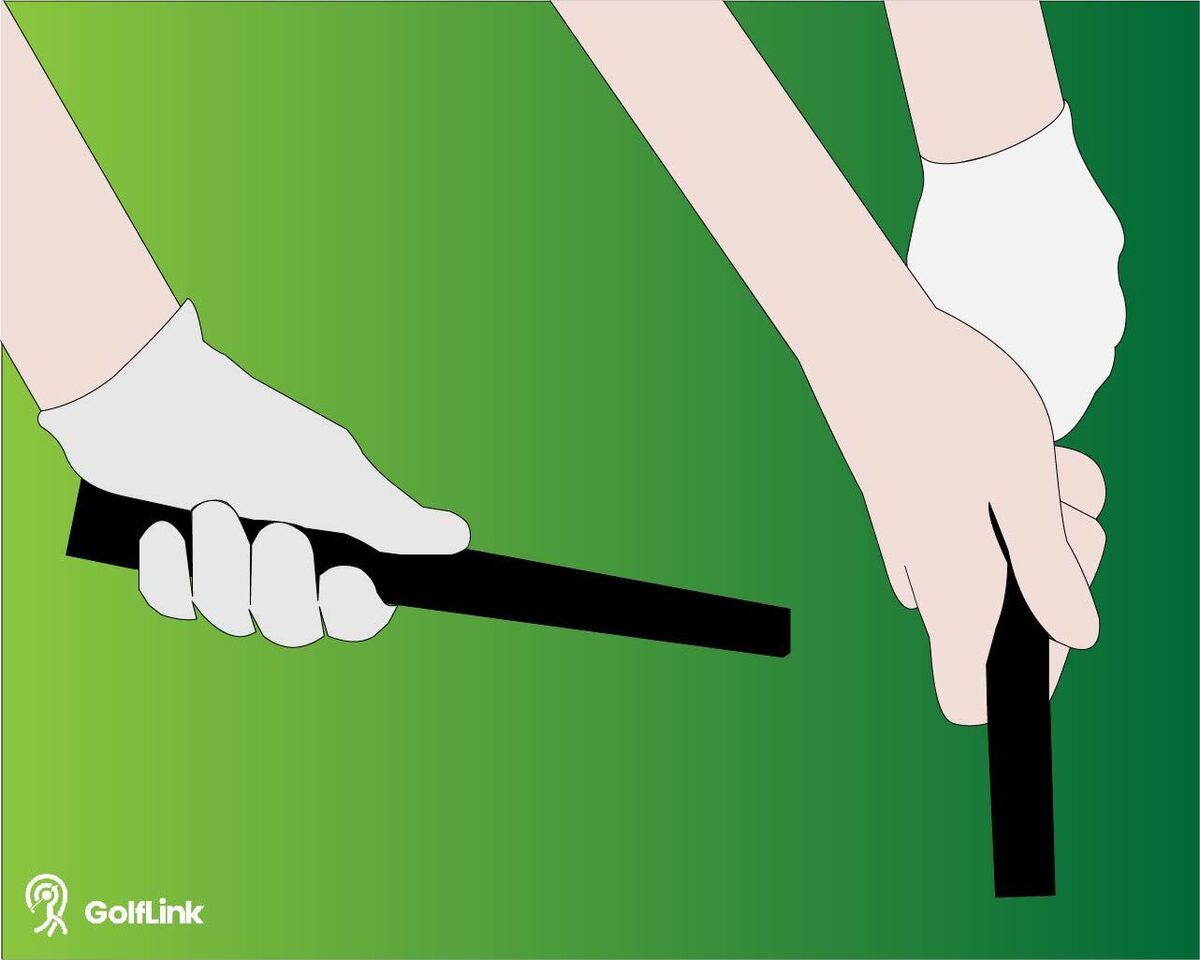
Next, your left index finger will slide between your pinkie and ring finger of your right hand as your right hand grips the club below the left. This is known as an “interlocking” grip.
A great checkpoint to confirm you've got the perfect grip is to make sure the "V" shape created by your thumb and index finger on each hand points towards your trail shoulder once you've taken the proper posture.
A slight variation of the interlocking grip is the overlapping grip, in which your right pinkie finger lays over your left index and middle fingers, with all other fundamentals staying the same.
Alignment
Establishing proper alignment in your golf swing will build strong fundamentals as your game progresses. To practice perfect alignment, lay a golf club or alignment stick in front of your ball and point it at your target. Then set up to the ball and make sure your club face is aimed down the line, and your feet, knees, hips and shoulders are parallel to that line as well.
Another great visual to establish proper alignment is to place an alignment stick across your shoulders or hips and address the ball in your proper posture. Follow the alignment stick and make sure it’s pointing at your desired target. If it's not, adjust accordingly.
Ball Position
Once you master the PGA of proper setup, there's just one more key to setting your golf swing up for success. Ultimately, how well you strike the ball will be determined by your ball position.
On iron shots, the ball should be played out of the middle of your stance. This is because you want to strike the golf ball with a descending blow.
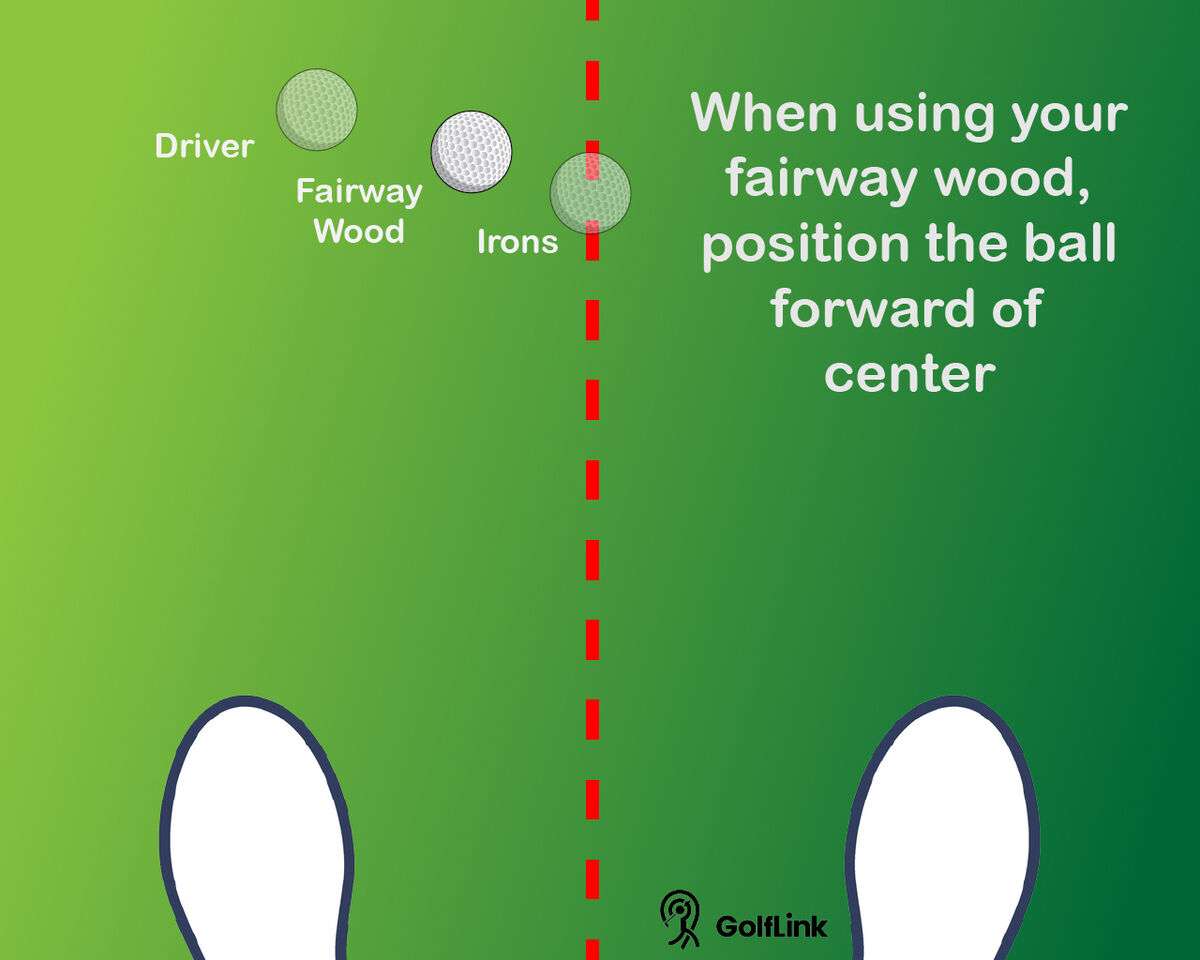
Ball position for driver, fairway woods and irons
With your hybrids and fairway woods, should move the ball up in your stance (closer to your left foot for right-handed golfers).
When hitting your driver, move the ball even further up in your stance so it's aligned with the inside of your left heel. With hybrids, fairway woods, and drivers, you want to hit the ball with a neutral to ascending angle of attack.
To make sure you've got the perfect ball position for your swing, try setting up with the posture, grip and alignment established above, but with no ball. Make a few swings and take note of where the club contacts the turf. To ensure ball-first contact, place the ball about an inch behind the bottom of your swing arc, then fire away.
The Fundamental Golf Swing
Proper setup may be the most important step of the golf swing, but let's face it, the fun doesn't begin until the club starts moving. Now that you've nailed the setup, here's how to convert it into a picture-perfect golf swing.
If you've ever watched "Happy Gilmore", and even if you haven't, you've probably heard the famous golf advice "it's all in the hips." This advice, which was actually directed at Happy's helpless putting stroke, should actually be the foundation of your full swing.
The hips are the driving force behind your swing, initiating both the backswing and the downswing.
The other concept that applies to each element of the swing is to stay in your posture. Focus on maintaining your spine angle from your setup through your backswing, and most importantly your downswing. Executing this simple move will eliminate many of the treacherous misses that plague too many golfers.
Backswing
Initiate the backswing by rotating your hips away from the target. As your weight shifts to your trail foot, allow your arms to naturally raise and your shoulders to turn.
At the top of your backswing, your hips should have rotated about 45 degrees, while your shoulders should rotate a full 90 degrees with your back to your target. Your lead shoulder should be under your chin and with the ideal wrist-cock, the shaft of your club should be parallel, or just shy of it, to the ground.
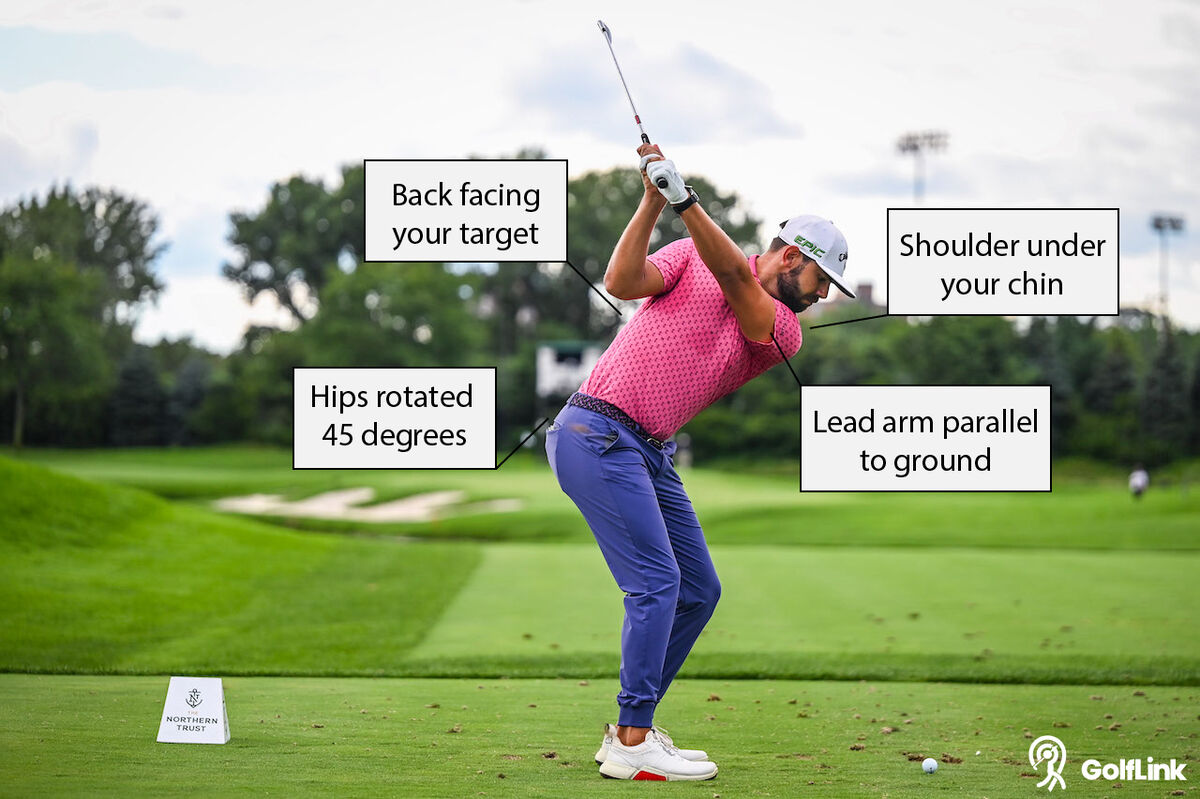
It’s important to make sure you’re on plane in your backswing. Doing so produces a good position at the top of your swing and follow through. Staying on plane means the club travels on the same arc throughout your golf swing.
To get a feel for the perfect plane, try this simple "handshake" drill. Take your club back about 20% of the way and stop. At this point in the backswing, you should feel like you’re reaching back to shake hands with someone.
Golf Swing Transition
Transitioning from your backswing to your downswing should be as smooth as possible. If you look at any professional golfer’s swing, you’ll notice there isn’t a lot of movement when in this position.
A good transitional thought as you reach the top of your backswing and transition into the down swing is "pause." What might feel like a long pause at the top of your swing is in reality just an extra split second for your mind and body to begin transitioning into your downswing. Try to notice the feel of being "wound up" on your trail side, as you're about to "unwind" into a smooth downswing.
Downswing
Just like with the backswing, allow your hips to initiate the downswing. Unwind your lower body from the ground up, allowing your arms to drop naturally through the ball.
You shouldn’t rush to complete your downswing. Concentrate on shifting your weight from your right to left foot while keeping your eye on the golf ball.
The Finish
You should be completely committed to swinging through the golf ball. You’ll know that you’ve done so when you extend your arms towards the target after you’ve hit the ball.
Complete your swing with a big finish that includes perfect balance, your chest pointing to your target, and most of your weight on the outer heel of your lead foot.
Diagnosing the Swing
It’s nearly as important to create good habits after you strike the ball as it is before you hit it. After all, what the ball does is directly related to what you did in your swing, meaning if you don't like the result, the answers lie in your ball flight.
Here's a quick look at some of the common misses golfers experience, with guidance on how to correct these issues.
Fat Shots
If your ball, and a large chunk of earth, each flew about 20 yards, you've hit a fat shot, also known as a chunk. There are many causes of fat shots, but one of the most common is when the upper body initiates the downswing instead of the hips and lower body. Try devoting extra attention to starting the downswing with the hips.
Thin Shots
Hitting thin shots, also known as skulling or blading the ball, is also quite frustrating. When you do this, the ball elevates only about a foot off the ground and usually flies about 50 percent farther than intended. There are several things that could cause thin shots, and Chuck Cook details a few easy ways to fix the issue.
Hooks & Slices
Maybe you made decent contact but your ball sailed hard left or right. This ball flight will tell you if you’re coming into impact with an open (slice) or closed (hook) club face.
Main Focus
In the early stages of building your golf swing it’s important to keep realistic expectations. Not one single person learned this game overnight. It takes practice and improvement is gradual, yet rewarding.
Stay focused on these key fundamentals and you will be on your way to solid ball-striking.