Skills & Drills: How to Practice Golf at Home
Here's how to practice golf at home and build consistency in your golf game

Winter doesn't have to mean your golf game goes into hibernation. Whether you're stuck indoors because of snow, rain, or just a busy schedule, practicing at home is one of the most effective ways to improve your game.
In my two-plus decades helping students get better at golf, I've seen students make incredible progress during the offseason simply because they committed to working on fundamentals in their living room or garage. In fact, several of my remote students live in places covered in snow right now. We do some of our best work together in the winter, away from the golf course.
The key is to focus on skills that directly translate to the course. You don't need a full driving range to get better. Some of the most important aspects of golf are best practiced in a controlled environment where you can really dial in the details. Here are my top recommendations for what to work on when you're practicing golf at home.
1. Putting Stroke Fundamentals
Let's start with the most obvious one because it's also the most important. Putting accounts for roughly 40% of your score, yet most golfers spend less than 10% of their practice time on it. Your living room or hallway is the perfect place to groove a consistent stroke.
The Drill: Set up a straight 6-foot putt on a quality putting mat. Focus on keeping your shoulders, arms, and putter moving as one unit. No wristy flips or jabs. Make 10 putts in a row before you're done for the day.
What to Check: Place an alignment stick or yardstick along your target line. Your putter face should stay square to this line throughout the stroke. Film yourself from face-on to check that your head stays perfectly still and your shoulders rock like a pendulum. Once you're consistently making 8-out-of-10 or more, try to hit 15 in a row, then 20.

7 Best Putting Drills for Real Results on the Course
2. Grip Pressure and Hand Position
Your grip is your only connection to the club, and most golfers hold on way too tightly. Home practice is perfect for ingraining the right grip pressure because you can work on it without being distracted by where the ball goes.
The Drill: Hold a club in your normal grip and rate your pressure on a scale of 1 to 10, with 10 being as tight as possible. Most people grip around a 7 or 8. You want to be at a 4 or 5. Practice making slow-motion swings while maintaining that lighter pressure. Do this for five minutes every day.
What to Check: Your forearms should feel relatively relaxed, not tense. At address, you should be able to feel the weight of the clubhead. If someone tried to pull the club from your hands, you could tighten up to resist, but at rest, you're holding it like you'd hold a small bird. Firm enough that it won't fly away, but gentle enough that you won't hurt it.

Master the Proper Golf Grip in 5 Easy Steps
3. Balance and Weight Transfer
Good golfers stay balanced throughout their swing. Home practice lets you work on this without worrying about where the ball goes.
The Drill: Make full swings without a ball, focusing on finishing in a complete, balanced position. Hold your finish for 3 seconds. If you wobble or step out of it, you're swinging too hard, or your sequencing is off. Do 20 swings per session.
What to Check: At the finish, 90% of your weight should be on your front foot. Your back foot should be up on the toe with the sole of your shoe facing behind you. Your belt buckle should face the target. If you can't hold this position steady for three seconds, slow down your swing until you can.
4. Swing Plane and Path
If you’ve got access to a launch monitor, you have a great opportunity to hone in your swing plane and path. Understanding your swing plane is crucial for consistent ball striking. Many launch monitors give you immediate feedback that used to require expensive lessons with video analysis.
The Drill: If you have a hitting net and mat set up with a launch monitor, hit 20 shots with a 7-iron, focusing purely on your swing path. Don't worry about distance. Just try to create a consistent path number (ideally between 0 and 2 degrees in-to-out for most golfers).
What to Check: The launch monitor will show you your club path in degrees. If you see significant variations (like -5 one swing and +8 the next), then work on your consistency before worrying about the exact number.
Film your swing from down the line and check that your hands and club are staying on a consistent plane throughout the backswing and downswing.

What Causes a Golf Slice and the Easiest Way to Fix It
5. Impact Position Drill
Impact is the moment of truth in golf. Everything else is just preparation for that split second when club meets ball.
The Drill: Get into your address position, then slowly move into your ideal impact position. Your hips should be open, hands ahead of the ball, weight favoring your front side, and shaft leaning toward the target. Hold this position for 10 seconds. Repeat 10 times.
What to Check: Take a photo of yourself at impact position from face-on. Your hands should be ahead of the ball. Your head should be slightly behind the ball. There should be a straight line from your lead shoulder down through your lead arm to the club. This is the position you're trying to return to at speed during your actual swing.
6. Tempo and Rhythm
Tempo is one of those things that separates good ball strikers from inconsistent ones. Home practice is ideal for this because you can use a metronome or counting method without distraction.
The Drill: Train a 3-to-1 ratio of backswing to downswing. Count "one-two-three" on your backswing and "one" on your downswing (the one-count on the downswing should get you to the impact position, not your finish position). Make 30 practice swings with this tempo. It will feel slow at first, but that's the point.
What to Check: Film yourself and watch the video. Your backswing should take three times as long as your downswing. If you rush the backswing or decelerate through impact, adjust your count. The goal is smooth acceleration, not a quick jerk back and a lunge forward.

Master The Proper Golf Swing: Step-By-Step Guide With Pictures
7. Short Game Touch
Chipping and pitching require feel and touch that you can absolutely develop at home. You don't need to hit full shots to work on this.
The Drill: If you have a net, practice hitting soft chips and pitches with different clubs (a sand wedge, a pitching wedge, a 9-iron). Focus on landing the ball on a specific spot on your mat. If you don't have a net, make practice swings focusing on brushing the ground in the exact same spot every time.
What to Check: For chips, your hands should stay ahead of the clubhead through impact. The sound of contact should be crisp, not chunky. If you're hitting into a net with a launch monitor, check your spin rates and launch angles. A good chip typically launches between 15 and 25 degrees, depending on the club.
Recommended Products for Home Golf Practice
You can practice golf from home with little to no equipment during the offseason, but if you want to take your training to the next level, here are a few products we recommend that can help you get the most out of your efforts.
PrimePutt Putting Mat
This is my go-to recommendation for students who want to practice putting at home. The surface rolls true and consistent, which is critical because you don't want to ingrain a stroke that compensates for a bumpy carpet.
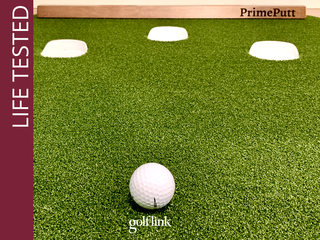
PrimePutt: Is This Life-Like Putting Mat Worth It?
FlightScope Mevo Gen 2 Launch Monitor
This is a game-changer for home practice. You get accurate data on club speed, ball speed, spin rate, launch angle, and swing path without spending $20,000 on a professional system. The immediate feedback helps you understand what your swing is actually doing versus what it feels like it's doing.
Quality Hitting Mat and Net
Don't cheap out here. A good mat protects your joints and gives you realistic feedback at impact. Pair it with a durable net that can handle full swings and you've got a practice setup that will last for years. Look for mats with some give to them so you're not jarring your wrists on every shot.
Building Consistency From Home
The beauty of home practice is building consistency. Fifteen minutes a day will do more for your game than a two-hour range session once a week. Pick two or three of these drills, commit to them for a month, and I guarantee you'll see improvement when you get back on the course.