Dial in Your Driver: Ideal Numbers & How to Hit Them
Check out the ideal launch monitor numbers for driver for all swing speeds, and how to hit them!

If you've ever stepped into a launch monitor bay at your local golf shop or indoor simulator, you know the feeling: data everywhere.
Ball speed, club speed, launch angle, spin rate, smash factor, attack angle, club path, face angle. It just keeps coming.
While all this information can be incredibly valuable, it can also leave you wondering, "what the hell am I supposed to do with all this?"
Here's the thing: not all launch monitor numbers are created equal. Some metrics actually matter for your game, while others are just noise.
The ideal launch monitor numbers for one golfer might be terrible for another. A tour pro swinging at 120 mph needs completely different numbers than a recreational golfer swinging at 85 mph.
Today, we're cutting through the noise and focusing on what actually matters for your driver.
I'll give you specific target ranges based on your swing speed, and explain what each metric really means (in plain English). I’ll also share some practical tips, based on my two-plus decades of teaching experience, that you can actually use to hit the ball longer and straighter with your driver.
Understanding Your Swing Speed Category
Before we get into the weeds with specific metrics, you need to know which swing speed category you fit into. This is your starting point for everything else, because your ideal launch conditions are directly tied to how fast you swing your driver.
Slow Swing Speed: Less than 85 mph
This is typically where you'll find senior golfers, many women golfers, and folks who are newer to the game. If this is you, your main job is to maximize carry distance. To accomplish that, you need a higher launch and enough spin to keep that ball in the air as long as possible.
Medium Swing Speed: 85-105 mph
This is where most recreational golfers live (probably you, if we're being honest). The good news? You've got some real flexibility here. Small tweaks to your launch conditions can add serious distance without having to swing harder.
Fast Swing Speed: 105+ mph
If you're swinging this fast, you're likely a competitive amateur, college player, or pro. You're already generating plenty of ball speed, so now it's about dialing in your launch angle and keeping spin under control to optimize distance.
Target Ranges by Swing Speed
Now let’s get specific. These are the target ranges for the most important launch monitor metrics. Think of these as your benchmarks for maximizing distance and keeping the ball in play.
Ideal Driver Numbers for Swing Speeds Under 85 MPH
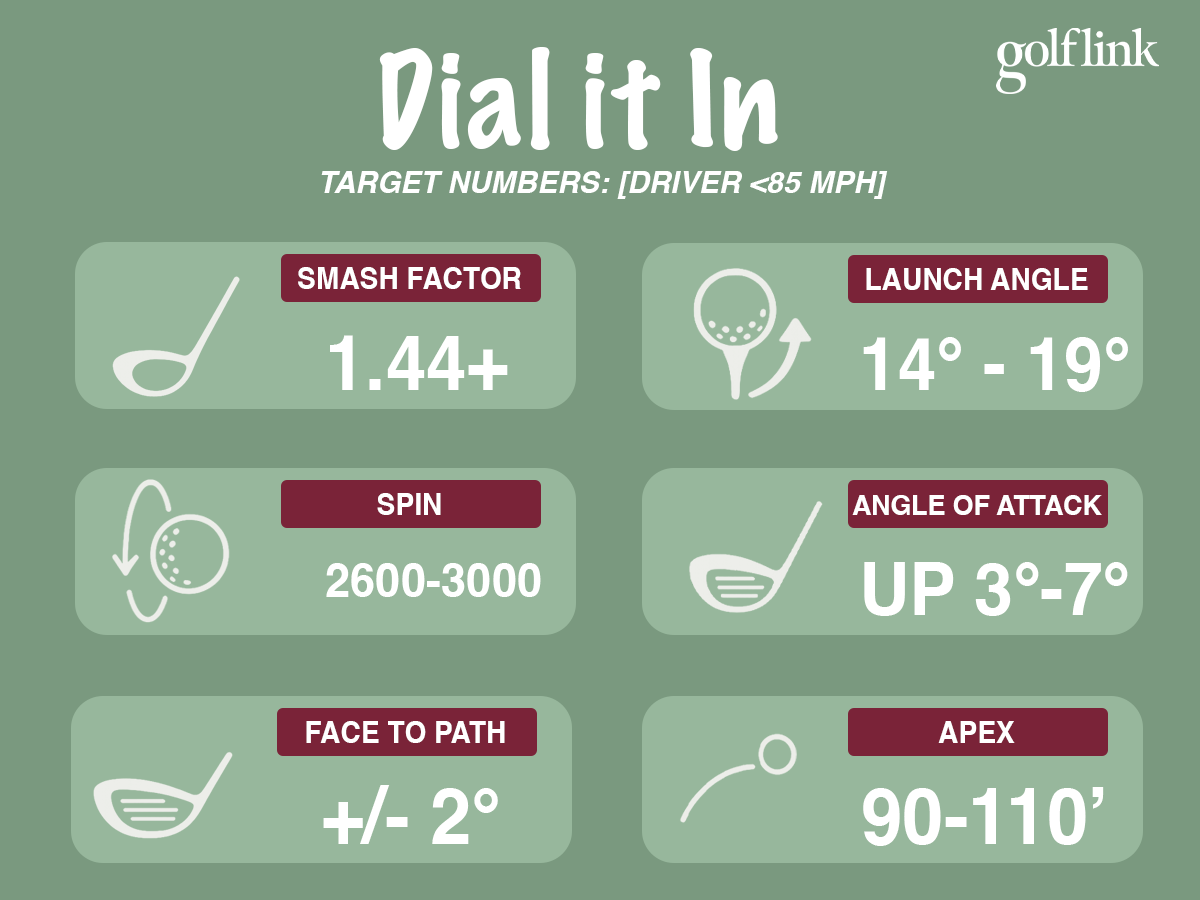
Your number one goal at this swing speed is carry distance. Since you're not generating massive ball speed, you need to keep the ball airborne as long as possible.
That means launching it higher (14-19 degrees) with enough spin (2,600-3,000 rpm) to maintain lift.
And here's something crucial: you want a positive angle of attack (+3 to +7 degrees). In other words, you should be catching the ball on the upswing to maximize distance, not chopping down on it.
|
Metric |
Target Range |
|
Launch Angle |
14-19 degrees |
|
Spin Rate |
2,600-3,000 rpm |
|
Smash Factor |
1.44-1.50 |
|
Face-to-Path |
-2 to +2 degrees |
|
Angle of Attack |
+3 to +7 degrees |
|
Apex |
90-110 feet |
Ideal Driver Numbers for Medium Swing Speeds (85-105 MPH)
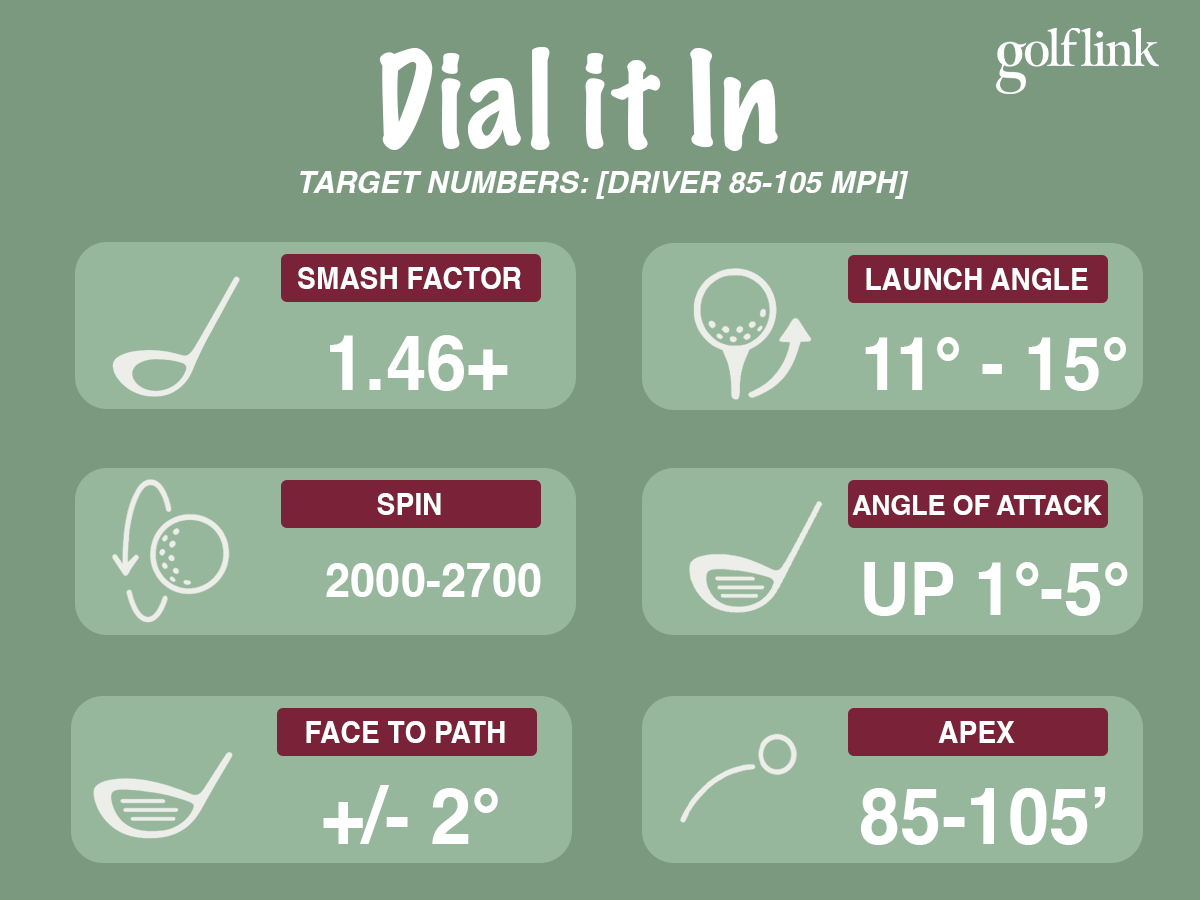
You're in the sweet spot here. You can optimize both carry and roll, which is where the real distance comes from. Your launch should be somewhere between 11-15 degrees (high enough to carry, but not so high it balloons).
Spin-wise, you're looking at a target of between 2,000 to 2,700 rpm. A slightly positive angle of attack (+1 to +5 degrees) helps you nail these numbers and max out your smash factor.
|
Metric |
Target Range |
|
Launch Angle |
11-15 degrees |
|
Spin Rate |
2,000-2,700 rpm |
|
Smash Factor |
1.46-1.50 |
|
Face-to-Path |
-2 to +2 degrees |
|
Angle of Attack |
+1 to +5 degrees |
|
Apex |
85-105 feet |
Ideal Driver Numbers for Fast Swing Speeds (105+ MPH)
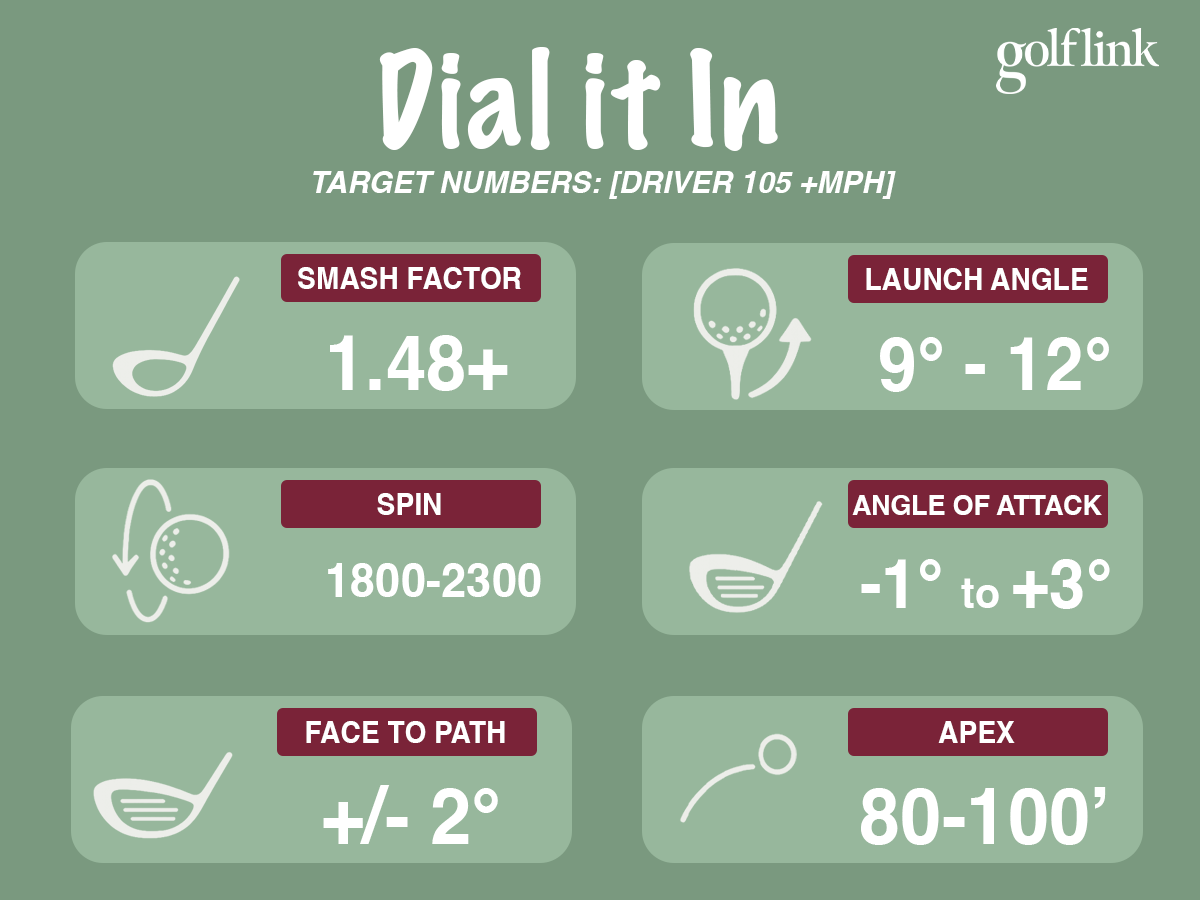
You're already generating serious ball speed, so now it's about optimizing launch and spin for maximum total distance. At this swing speed, you want a lower launch (9-12 degrees) paired with lower spin (1,800-2,300 rpm) to create that enviable penetrating ball flight that just keeps going then rolls out forever.
|
Metric |
Target Range |
|
Launch Angle |
9-12 degrees |
|
Spin Rate |
1,800-2,300 rpm |
|
Smash Factor |
1.48-1.50 |
|
Face-to-Path |
-2 to +2 degrees |
|
Angle of Attack |
-1 to +3 degrees |
|
Apex |
80-100 feet |
Understanding & Improving Each Metric
Let's break down what each of these metrics actually means, why you should care, and what you can do to improve them.
Launch Angle
Launch angle is the initial vertical angle of the ball when it leaves your clubface.
Launch angle is affected by:
- Angle of attack,
- Static loft of your driver
- Strike location on the club face face
- Swing speed
Why Launch Angle Matters:
Launch angle is huge for distance. Too low? The ball doesn't stay in the air long enough and you're leaving yards out there. Too high? Then it balloons, loses forward momentum, and falls short.
If you're a slower swinger, you need a higher launch angle to maximize carry. If you're faster, you can get away with a lower launch angle because you'll get a more penetrating flight with better roll.
How to Improve Launch Angle With Driver
If Your Launch Is Too Low:
- Move the ball forward in your stance (off your lead heel or even a touch ahead of it)
- Tilt your spine away from the target at setup
- Tee it higher (about half the ball above the top of your driver)
- Feel like you're staying behind the ball through impact
If Your Launch Is Too High:
- Check your equipment (you might need a driver with less loft or need to lower the loft on an adjustable driver)
- Move the ball back slightly in your stance
- Set up with less spine tilt
- Try to catch it more in the center or slightly below the center of the face
Spin Rate
Spin rate is the speed at which the ball rotates as it flies through the air, measured in rpm. With the driver, we're talking about backspin, which creates lift and has a massive influence on distance.
Why Spin Rate Matters:
Too much spin and the ball climbs too high, balloons, and dies. You're basically fighting yourself. Too little spin and the ball drops out of the sky like a rock. Spin also amplifies any curve on your shots. With too much spin, a little fade can become a big slice, and a slight draw can become a snap hook. Generally speaking, the faster you swing, the less spin you want.
How to Improve Spin Rate With Driver
If Your Spin Is Too High:
- Work on your strike location (you want center face or slightly toward the toe and a bit above center)
- Hit more up on the ball (increase that angle of attack)
- Look into low-spin equipment (modern drivers and shafts can have a huge impact on spin)
- Shallow your downswing and swing more from the inside
- Try strengthening your grip slightly
If Your Spin Is Too Low:
- Dial back your angle of attack just a bit
- Focus on hitting the center of the face
- You might need a driver with more loft

Master the Proper Golf Grip in 5 Easy Steps
Smash Factor
Smash factor is the ratio of ball speed to club speed. If you swing driver 100 mph and your ball comes off at 148 mph, that's a 1.48 smash factor.
The theoretical max is 1.50, thanks to USGA rules limiting how hot driver faces can be.
Why Smash Factor Matters:
This is your efficiency number. It tells you how well you transfer energy from club to ball.
Higher smash factor means more ball speed and more distance from the same swing speed. Here's a crazy stat: two golfers swinging at the exact same speed can be 15-20 yards apart just based on smash factor.
Here's the kicker: if your smash factor is low, you don't need to swing harder. You just need to make better contact.

How to Shallow the Golf Club
How to Improve Smash Factor With Driver
- Center-face contact: Grab some impact tape or foot spray to see where you're really striking it.
- Fundamentals: Keep your posture, steady your head, work on tempo
- Check Your Equipment: Wrong shaft flex, length, or lie angle makes solid contact way harder
- Swing Easy: Try swinging at 80-85% effort and focus on pure contact
- Tempo: Smooth your transition from backswing to downswing
Face-to-Path
Face-to-path is the difference between where your clubface is pointing at impact and the direction of your club path at impact. Face-to-path is measured in degrees.
Why Face-to-Path Matters:
Face-to-path determines your shot shape. The club face is about 75-85% responsible for where the ball starts, but it curves based on the relationship between face and path. A face that’s open to the path creates a ball that curves right (for a right-handed player) which could be a fade or a slice, depending on the severity.
If the face closed to the path? The ball curves left (for a right-handed golfer). Understanding this relationship is the key to fixing your slice or hook.
How to Improve Face-to-Path
If Your Face Is Too Open (Hello, Slice):
- Stronger Grip: Rotate both hands toward your trail side
- Forearm Rotation: Feel like you're rotating your forearms through impact
- Grip Pressure: Lighten up on your grip pressure, especially with your lead hand
- Shallower Path: Shallow the club out and swing more from the inside
If Your Face Is Too Closed (Welcome to Hook City):
- Weaker Grip: Rotate your hands more toward the target
- Body Rotation: Focus on rotating your body through impact, not just your hands and arms
- Neutralize: Work on a more neutral release and a more neutral swing path
Angle of Attack
Angle of attack is the vertical direction your club is moving when it hits the ball. Positive means you're hitting up on it (ascending), negative means you're hitting down on it (descending).
Why It Matters:
With the driver, you want to be hitting up on the ball (positive AoA). This launches it higher while actually reducing spin. It's the perfect combo for distance. Hitting down on your driver? That's a distance killer. You get lower launch and higher spin, which is exactly backwards from what you want. I've seen this cost amateur golfers 20-30 yards or more. It's probably the single biggest mistake I see on launch monitors.
How to Improve Angle of Attack
If Your Angle of Attack Is Too Negative:
- Move the ball forward in your stance (this is the most effective fix)
- Tee it higher
- Set up with more spine tilt away from the target
- Try widening your stance a bit
- Feel like you're staying behind the ball through impact
If Your Angle of Attack Is Too Positive:
- Move the ball back slightly in your stance
- Set up with less spine tilt
- Tee it a little lower
Apex
Apex is just the maximum height your ball reaches during its flight, measured in feet. It's the result of your launch angle, spin rate, and ball speed all working together.
Why Apex Matters:
Apex tells you if your ball flight is actually optimized.
If your apex is too low, you're not getting all the carry distance you could be getting from your swing. If your apex is too high, you're ballooning it, and also losing distance.
Here's a quick rule of thumb: your apex (in feet) should be roughly 10-12% of your carry distance (in yards). So if you're carrying it 250 yards, you're looking for an apex around 75-90 feet.
How to Improve Apex
If Your Apex Is Too Low:
- Increase your launch angle (ball forward, tee higher, more spine tilt)
- Check your spin rate and make adjustments if needed
- Consider adjusting your driver to a higher loft setting (if applicable) or a higher lofted driver
If Your Apex Is Too High:
- Reduce your spin rate (better strike location, more positive attack angle)
- Optimize your launch angle for your swing speed (as noted earlier)
- Consider reducing the loft if your driver is adjustable, or switching to a driver with lower loft
Putting It All Together
Understanding these launch monitor numbers is just the starting point. The real magic happens when you realize that all of these metrics work together to create your ball flight, and ultimately, your distance.
Start with your swing speed category. That's your foundation. Then look at which metrics are furthest from your target range.
If your smash factor is too low, fix that first because there’s no point in optimizing launch and spin if you're not making solid contact.
Once you're striking it consistently, fine-tune your launch conditions.
The best part about this is that small changes make a massive difference. Tiny tweaks like moving your ball position forward an inch, teeing it a quarter-inch higher, or adjusting your spine tilt just a bit. can completely change your launch angle and angle of attack.
Improving your strike location by a few millimeters can dramatically boost your smash factor and drop your spin.
Don't be shy about getting help, either. A good club fitter can dial in your equipment, and a solid instructor can help you make the swing changes you need.
Honestly, the combination of proper equipment and better technique is the fastest way to better driver performance.
Use these target ranges as your guide. Track your progress on a launch monitor. Make small improvements over time. Before you know it, you'll be bombing your driver longer and straighter than you ever have, and you'll have the numbers to back it up.