
How many yards would you give up off the tee to hit four more fairways? Not four more fairways per round, four more per 100 tee shots.
If you’re debating between 3-wood and hybrid off the tee, that’s ultimately what the decision comes down to. The average 10-handicap player hits four more fairways per 100 tee shots with hybrid than with 3-wood, and gives up eight yards every time they make that choice.
Is that trade off worth it? We dug deep into Shot Scope’s statistical database to answer that question and help you decide which club gives you the best chance in every situation.
3 Wood vs. Hybrid: How We Compared Them
We pored over Shot Scope’s stats database, which by now has accumulated in the neighborhood of 500 million shots, to get valuable insights on what actually happens when golfers choose between 3-wood and hybrid on the golf course. For distances, we used Shot Scope’s P-Avg number (Performance Average) which removes significant long and short outliers. The result is we’re comparing average strikes, not chunks, tops and shanks that drag down an average or balls that rode the cart path for an extra 50 yards.
In case you’re not familiar Shot Scope tracks shots in real rounds and gives golfers an in-depth look at their own game, their strengths and weaknesses, and exactly how many strokes they gain and lose in every facet compared to virtually any benchmark they choose. Meanwhile, Shot Scope has compiled a massive database of how golfers from every skill level perform from every area of the golf course with every club. That’s the information we’re using today.
One number you'll see is P-Avg. That's the average distance with unusually long and short shots (shanks, tops, ricochets) removed, so it shows the distance that a normal strike produces.
Individual results will vary. But when thousands of golfers at the same skill level hit the same club, the averages paint a pretty clear picture of what the smart play is.
Off the Tee: What You Gain and What You Give Up
Off the tee is where most golfers debate between hybrid and 3-wood. With a 3-wood, you gain distance. That’s no surprise. It’s a lower launching club with a longer shaft and a bigger head.
With a hybrid, you gain fairways. That might not be shocking, but it’s not a given, either. Here’s how that distance-to-fairways comparison plays out for every handicap from scratch to 15.
HCP | 3 Wood Distance (P-Avg) | Hybrid Distance (P-Avg) | 3 Wood Distance Advantage | 3 Wood Fairway% | Hybrid Fairway% | Fairway% Difference |
0 | 267y | 250y | +17y | 49% | 56% | +7% |
5 | 245y | 226y | +19y | 51% | 58% | +7% |
10 | 233y | 225y | +8y | 52% | 56% | +4% |
15 | 224y | 219y | +5y | 46% | 45% | -1% |
The distance gap gets bigger as skill improves. A scratch or 5-handicap golfer gains closer to 20 yards off the tee with the 3-wood. For 10 and 15 handicap players, that advantage drops to 8 and 5 yards.
When it comes to what you get in exchange for that distance cost, the 0 and 5 handicap players see a 7-point improvement in fairways hit. In other words, for every 100 tee shots, you’d hit seven more with the hybrid than 3-wood but you'd give up roughly 17 to 19 yards to find those extra fairways. At 10 handicap, you'd give up 8 yards off the tee – still close to one less club into the green – for four more fairways out of 100 tee shots.
For the average 15-handicapper, who hits 3-wood farther and finds about the same fairways, the choice is obvious (before you factor in any trouble that may be lurking). For the 0-10 handicappers, would you give up somewhere between 8-19 yards on every decently struck tee shot in exchange for hitting one extra fairway every 14-25 swings? I know what I'd do.
But on some holes there’s more to your decision than fairways and distance.
Where the Misses Go
When facing a hole that brings trouble into play, like a penalty area or a bunker, there’s more to consider. Across every skill level (with the exception of the 10-handicapper for some reason), the hybrid is the clear winner for avoiding a bunker.
Meanwhile, 15-handicappers are much more likely to avoid penalty areas when taking hybrid rather than 3-wood, but that turns into a virtual tie as skill advances to 10-handicap and lower.
HCP | Club | Fairway | Bunker | Penalty |
0 | 3 Wood | 49% | 5% | 1% |
0 | Hybrid | 56% | 2% | 1% |
5 | 3 Wood | 51% | 3% | 1% |
5 | Hybrid | 58% | 1% | 1% |
10 | 3 Wood | 52% | 1% | 2% |
10 | Hybrid | 56% | 1% | 3% |
15 | 3 Wood | 46% | 4% | 5% |
15 | Hybrid | 45% | 1% | 1% |
Into the Green: Hybrid Dominates
On approach shots, it isn't close. At every handicap level, the hybrid hit more greens and finished closer to the hole than the 3-wood, on average. And, though it’s not a straight line, the advantage increases overall as handicap increases.
The hybrid hit about twice as many greens at most handicap levels (11% vs. 6% at 10 handicap) and finished 20 to 63 feet closer. In a lot of cases, that’s the difference between facing a two-putt for par and trying to get up-and-down to avoid bogey.
The caveat is that hybrid approaches come from shorter distances on average, so unlike off the tee, this isn’t exactly an apples-to-apples comparison.
But even though a good chunk of that difference can be attributed to a shorter starting distance for the hybrid, we’ve already proven that hybrids beat fairway woods at holding greens. They spin more, land steeper, and stop quicker, which all help when you need your ball to stick on the green.
HCP | 3 Wood Greens Hit | Hybrid Greens Hit | 3 Wood Proximity | Hybrid Proximity | Hybrid Finishes Closer By |
0 | 8% | 18% | 158' | 138' | 20' |
5 | 6% | 13% | 195' | 164' | 31' |
10 | 6% | 11% | 199' | 171' | 28' |
15 | 4% | 10% | 261' | 198' | 63' |
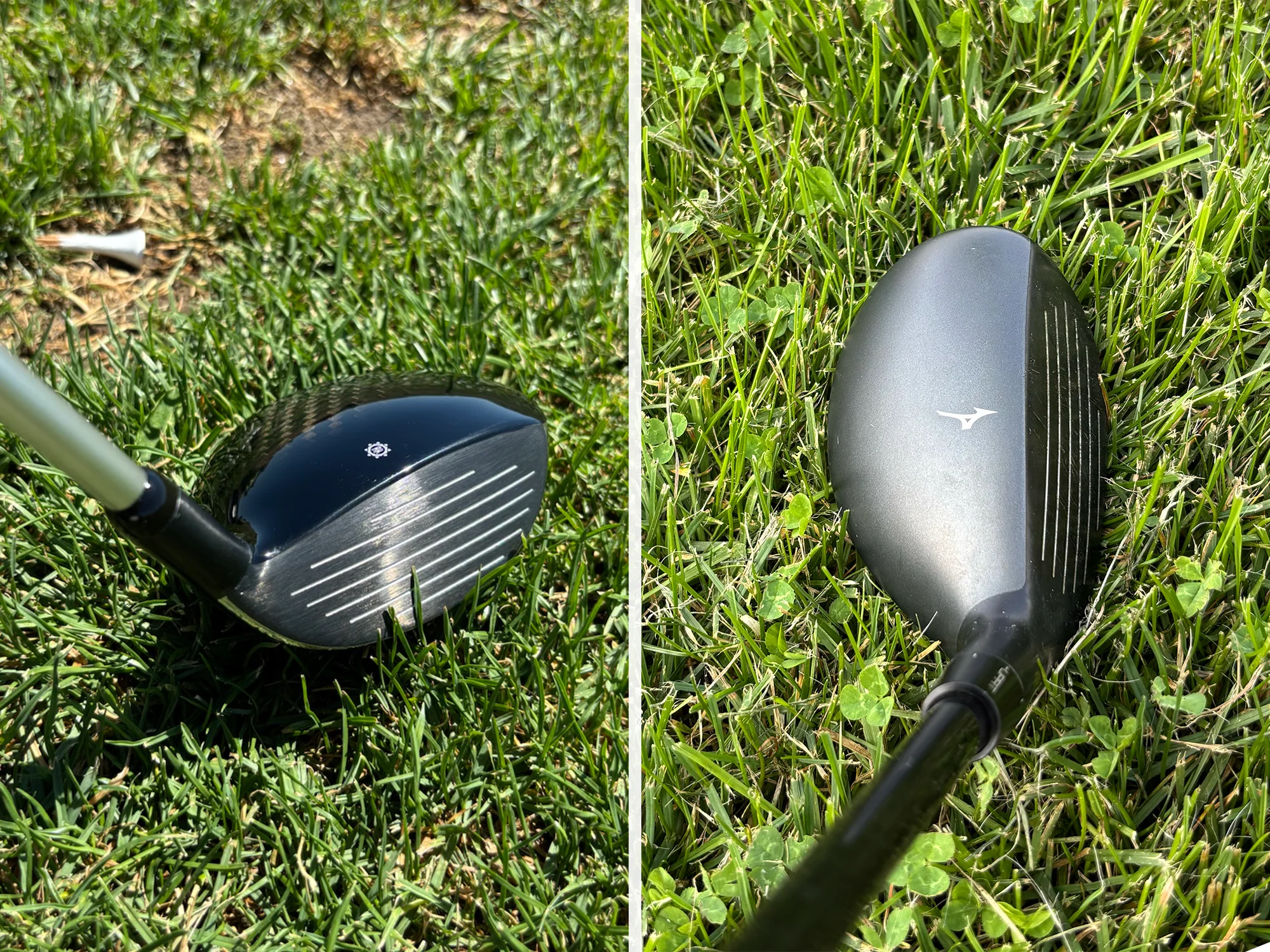
Which One Should You Choose?
Here are four situations, and what the data says about each.
1. Optimal Position on a Routine Tee Shot
If you’re looking for a driver alternative on a routine tee shot, 3 wood typically sets you up for success better than pulling hybrid off the tee. The slim fairways hit advantage does not negate the stark distance disparity.
3 Wood: Choose it when you’re looking for optimal position and fairway bunkers or penalty areas are not a concern.
2. Avoiding Trouble
When the hole presents fairway bunkers or penalty areas, or both, the statistics shift in favor of the hybrid. Every handicap range hits the same or fewer bunkers with the hybrid than the 3 wood (a sign that golf course architects are doing their jobs well) and while the gap in penalty areas found is small, the 15 handicap players do find them more often with 3 wood than hybrid.
Hybrid: Choose this when safety matters more than the extra yards.
3. Consider Your Handicap
The trade changes as your handicap goes up.
- Scratch and 5: The 3-wood buys 17 to 19 yards. The hybrid buys 7 more fairways per 100 shots and fewer bunkers. When there’s no bunker or penalty area to consider, this is what your decision comes down to.
- 10 and 15: The 3-wood's distance edge shrinks to 8 and 5 yards, and the hybrid only hits more fairways for the 10-handicapper (56% vs. 52% at 10). For 15-handicappers (close to the average of all male players who keep a handicap index) it stays out of trouble more often, finding significantly fewer penalty areas and bunkers.
4. You're Hitting Into a Green
Into the green, the hybrid wins at every skill level. It hit about twice as many greens as the 3-wood and finished way closer, even allowing for the fact that it's often hit from shorter distances.
Hybrid: Choose this for shots into greens.
3 Wood: Choose this when you're laying up to a distance or going for maximum yardage, and the green isn't the realistic target.
A Fair Question
The averages come from millions of shots, but they aren’t your averages. Tracking your own distance and dispersion with each club is the best way to make decisions based on how you actually perform on the course. But short of that, evaluating what happens on millions of other golfers’ shots is the next best thing, and the data tells a clear story.
The 3-wood is for golfers who need the extra distance and can afford a couple extra misses. The hybrid is better when every last fairway hit counts more than every last yard, and for any shot into a green.