Rosses Point, Enniscrone and Carne Golf Courses - An Irish Golf Adventure
The Republic of Ireland's Northwest Coast
Ireland is shaped much like a saucer with mountains fringing the lip of the cup and bogland comprising much of the cup's internals. Glaciers scraped out dramatic valleys and ridges called eskers and left deep lakes. I took in this terrain on my 150 mile drive from Dublin to counties Sligo and Mayo on the northwest coast of the republic. There I stayed in two castles and a fine modern hotel, and I played three of Ireland's best links courses: County Sligo (Rosses Point), Enniscrone, and Belmullet (Carne).
The northwest coast stands in sharp contrast to Dublin and the eastern part of the country. The population is much sparser, the traffic far less dense. The pace of life is more relaxed and the scenery is perhaps as beautiful as anywhere in the country.
County Sligo (Rosses Point) and Markree Castle
My first stop on the northwest coast was Markree Castle in Collooney, a few miles east of the town of Sligo and a gateway to Yeats Country. Yeats spent much of his early life here, taking the majesty of the mountains, sea and lakes as inspiration for his early lyrical poems.
The castle, which dates back to the Cromwellian rampage through Ireland, was a gift of the English lord to his general, Edward Cooper, the first of generations of Coopers to live there. Having fallen into disuse by the 1980's, the castle was bought by Charles Cooper, a veteran hotelier and restaurateur and a descendent of the general. With its great hall and magnificent winding staircase, you might imagine at any moment bumping into Arthur and Guinevere coming down to dinner. If Charles had anything to do with it, their meal would have been unforgettable.
Markree Castle sits on wooded pasture land with a stream running through it and Cooper hopes one day to build a first class golf course on the land.
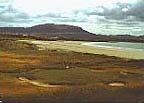
County Sligo, the golf course, lies just north of the town of Sligo on Rosses Point overlooking the Atlantic. To the East is Benbulben, a mammoth 1700 meter high rock mountain that looks like a loaf of bread. Host of several major championships, County Sligo was originally built in 1894 and reconstructed by H.C. Colt in 1928. It is a long, treacherous course especially in the wind, offering a mix of flat and winding holes that include fairways that toss this way and that like the sea in a storm. The signature hole is the dogleg left 17th, at 455 yards one of the hardest par 4's in the world. From a tee box in a valley you position your drive to the first fairway which is separated from the second fairway by thick rough and a stream. From there you have a monster second shot to a green at the top of a hill that almost requires a piton to mount. It is an awesome hole.
Enniscrone Golf Club and Belleek Castle
From County Sligo I made the 40 km drive south along the coast to the riverside town of Ballina, where I stayed at Belleek Castle near the mouth of the Moyne River. Run by a husband and wife, the castle has small but comfortable rooms, first class dining and a wood paneled bar lounge that reminded me of a galley in an old sailing ship. Delightful.
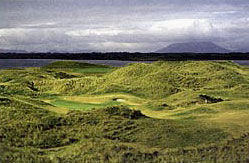
Nearby is Enniscrone Golf Club on Killila Bay and the Atlantic. The creation of the late Irish architect Eddie Hackett, who revised the original 9 holes and extended them to 18, the course winds along the bay and in and out of high sand dunes some of which form natural amphitheaters for mischievously contoured greens. In the summer of 1999, six new holes were created among the dunes out by the ocean. These holes, which replaced the flat, pedestrian opening holes, help ensure Enniscrone's stature as one of Ireland's top 10 links courses.
Bellmullet Golf Club (Carne) and Teach Iorrais
My last night was spent at the small village of Geesala in County Mayo. I stayed at Teach Iorrais (pronounced chock erris), a 3-star hotel run by a young couple who returned to Ireland after living in England. The 30 room hotel is excellently furnished and very comfortable. The staff were extremely friendly. Here on this site, John Millington Synge penned his famous play, 'Playboy of the Western World'.
The drive to Belmullet Golf Club took about 30 minutes. Belmullet, also called Carne, is another Eddie Hackett design constructed on a narrow peninsula overlooking Blacksod Bay to the East and South and the Atlantic to the West. To the south are the Nephin Beg mountains and Achill Island. Visible from the 13th and 14th holes are two small islands in the Atlantic that figured in a celebrated Irish fable called The Children of Lire. According to the legend, the children were turned into swans and banished to the islands for 300 years.
Carne was developed by a local resident-owned non-profit company to promote area tourism. The company instigated a land purchase agreement with local landowners to acquire enough acreage for the golf course. The club, which is run entirely as a non-profit endeavor, features a clubhouse with an outstanding restaurant.
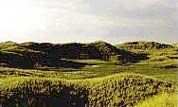
Carne GolfLinks is the most dramatically scenic of the three courses I played on the northwest coast. The course is laid out entirely on sand dunes, some of which rise to a height of 70 feet and more. Hole 11, a short par 4 of 332 yards, doglegs around a monster dune nicknamed by the locals Mt. Everest. Golfers daring enough to drive the green must go over this dune, and many inevitably wind up climbing up its steep slopes to look for their golf balls. If you are under the care of a physician, you might not want to play Carne. The hilliest course I have ever played, it exhausted me with its unending climbs.
An Irish Golf Adventure
- Royal County Down and Royal Portrush
- Royal Dublin Golf Course
- Druids Glen
- The K Club
- Rosses Point, Enniscrone and Carne
- Connemara
- Ballybunion
- Lahinch
- Galway Bay Golf & Country Club
- Dooks and Dingle Golf Courses
- Ring of Kerry
- Waterville
- Tralee
- Killarney
- Old Head
- Fota Island
- Mount Juliet
- Adare Manor & Golf Club