The 13 Best Golf Betting Games
These are our favorite golf gambling games, with easy-to-follow rules

Whether you’re looking for a little friendly competition or a serious money game, there’s no shortage of golf betting games that you can play within your group, or even when you're playing as a single.
Here are 13 of the best golf betting games to bring an extra layer of competition to your otherwise pedestrian round of golf. To help you find the perfect game for you, we catgorized each of these as either Welcoming, Competitive, Rowdy, or Different, depending on the tone it sets.
Welcoming golf games like a Stableford are great for newer golfers, or when there is a wide range of handicaps among golfers in the group.
Competitive games are ideal when you want to ratchet up the pressure and competitive juices.
Rowdy games are perfect when you're looking to have a great time, and may even indulge in some music and beverages throughout your round.
Different games are simply a great way to chage up the routine round.
1. Match Play
FULL MATCH PLAY RULES
Players: 1-4
Vibe: Competitive
The easiest change up from stroke play, match play takes into account a little more strategy and can be a lot of fun. Match Play is a head-to-head format that can be played one-on-one or as teams of two.
- Instead of marking strokes, you mark holes won. Tied holes have no value awarded to either side.
- The match is finished when the winning individual or team leads by more holes than remain to be played.
- The final score of the match is formatted as the number of holes the winner led by, followed by the number of holes that remained when the match ended. For example, if you took a two-hole lead on your opponent after the 17th hole, you would win by a final score of 2&1.
- You can even play match play as a single by playing against the course using your course handicap.

Complete Guide to Match Play in Golf (Plus Winning Strategies!)
2. Skins
FULL SKINS RULES
Players: 2-players
Vibe: Competitive
Skins is a fun competition that technically can be played as a twosome or threesome, but playing with four brings out some of the best results. One of the best aspects of a skins game is that even if you’re not having the best day on the golf course, one good hole can change your luck.
- Assign point values for each hole, and a dollar value for each point. Each hole could be worth one point, or holes could be worth more points based on difficulty or when they fall in the round, with the closing holes worth the most.
- The winner of a hole gets that hole’s “skin" and skins carry over to the next hole when two or more players tie on a hole.
- When multiple holes carry over and the hole you’re playing is worth a lot of points, things get really interesting. That's when serious momentum shifts occur.
- A skins game is also great for large tournaments or parties with multiple groups playing.

The Best 3 Person Golf Games
3. Wolf
FULL WOLF RULES
Players: 4
Vibe: Rowdy
Wolf is a great golf game to play with four players. It brings out the confidence in each player and is one of the only games in which teams vary from hole to hole.
- Wolf begins by determining the order in which the group tees off on the first hole. It’s important to note the order on the scorecard as you must follow this rotation throughout your round.
- On the first tee, the first player to tee off is the Wolf for that hole. After hitting their tee shot, the Wolf may elect to play against the other three golfers as a Lone Wolf for that hole. If Lone Wolf is elected, that individual is playing alone against the other three players and the hole is then worth triple the amount of points. Lone Wolf must be declared before seeing the second player tee off.
- After seeing the second player tee off, the Wolf determines if they will partner with that player before the third player tees off, and the same applies to the fourth player.
- If the Wolf does not make a partner selection after the third player tees off, they are automatically paired with the fourth player.
- Two teams of two then compete for a point on that hole and the lowest score on the hole wins the point for the team or Lone Wolf. Ties do not carry over.
- On the next hole, the second player in the order is now the Wolf. Remember that the Wolf alternates every hole and the Wolf always tees off first. At the end of the round, the player with the most points is the winner.

Wolf Golf Game: Official Rules (+How to Win!)
4. Vegas
FULL VEGAS RULES
Players: 4
Vibe: Rowdy
Vegas, much like the city itself, is high stakes and a golf gambler’s dream.
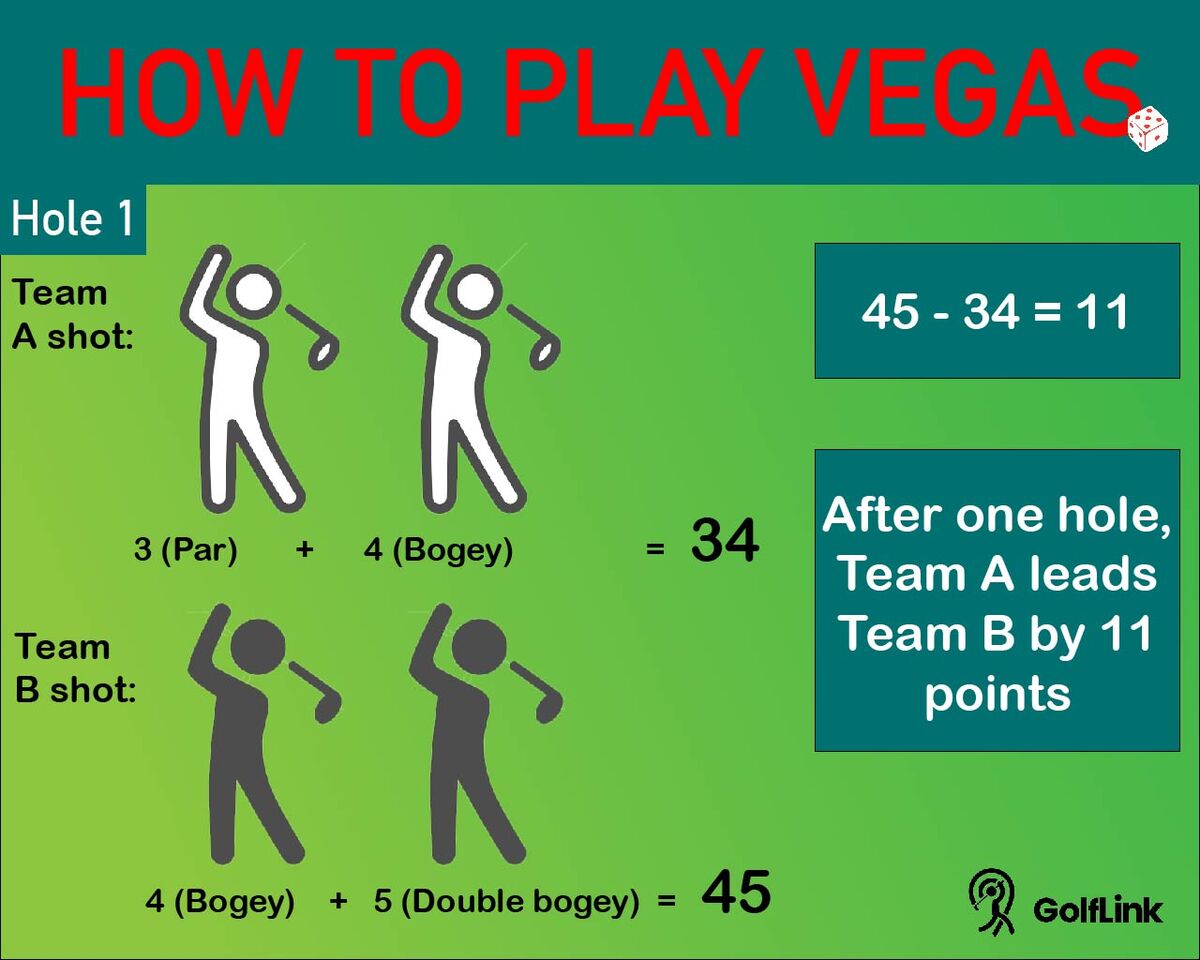
- The game consists of teams of two and instead of adding scores together, you pair them.
- For example, Bob makes a 3, and his playing partner, John, makes a 4, their team score for the hole becomes 34. Their opponents make a 4 and 5, their score is 45.
- Subtract the smaller score from the larger score and award that number of points to the team that won the hole. For that hole, Bob and John get 11 points, the difference between 45 and 34.
- What happens when a birdie drops? You flip the bird, of course. When one team makes a birdie, they can flip their opponent's score so the higher number is first. If you make a 4 and a 5 on a Par-5 and your opponents make a 5 and 6, they’ll have to take a 65 instead of 56.
5. Stableford
COMPLETE STABLEFORD RULES
Players: Any
Vibe: Different, Welcoming
Stableford is the ultimate risk versus reward scoring system in golf.
- Stableford is a point system, and unlike most golf games, the high score wins.
- Instead of tracking strokes, Stableford scoring assigns a point value to each score and the better you play, the more points you earn.
- Point values are based on a fixed target score, which is normally par. Points are earned on each hole and at the end of the round the highest score wins.
| Score | Stableford | Modified Stableford |
| Albatross | 5 | 8 |
| Eagle | 4 | 5 |
| Birdie | 3 | 2 |
| Par | 2 | 0 |
| Bogey | 1 | -1 |
| Double Bogey | 0 | -3 |
6. Alternate Shot
ALTERNATE SHOT RULES
Players: 4
Vibe: Competitive
Alternate Shot is played in teams of two. In Alternat Shot, you need to trust, rely on, and carry your playing partner. Alternate Shot is one of the formats in the Ryder Cup.
- Players alternate hitting each shot beginning with the opening tee shot of the round.
- The lowest team score on each hole wins. Ties to not carry over.
Playing Alternate Shot isn’t for everyone. You have to be able to deal with the pressure of not letting your partner down and coming through when important situations fall upon you.
7. Four-Ball
COMPLETE FOUR-BALL RULES
Players: 4-plus
Vibe: Competitive
Other Names: Best Ball
Four-Ball is a simple but fun approach to playing as teams of two. You can play with your foursome, use the Four-Ball format for a large tournament, or anything in between.
- Four-Ball scoring is simple. The team score for each hole is the lowest score made by either teammate.
- You can apply match play or stroke play format.
Four-ball allows for aggressive strategy based on what your playing partner has done and the position your competitors find themselves in.
8. Bingo Bango Bongo
BINGO BANGO BONGO RULES
Players: 2-4
Vibe: Welcoming
Bingo Bango Bongo can be a blast to play with two, three, or four players. It’s a point-based game with a total of 54 points up for grabs over 18 holes.
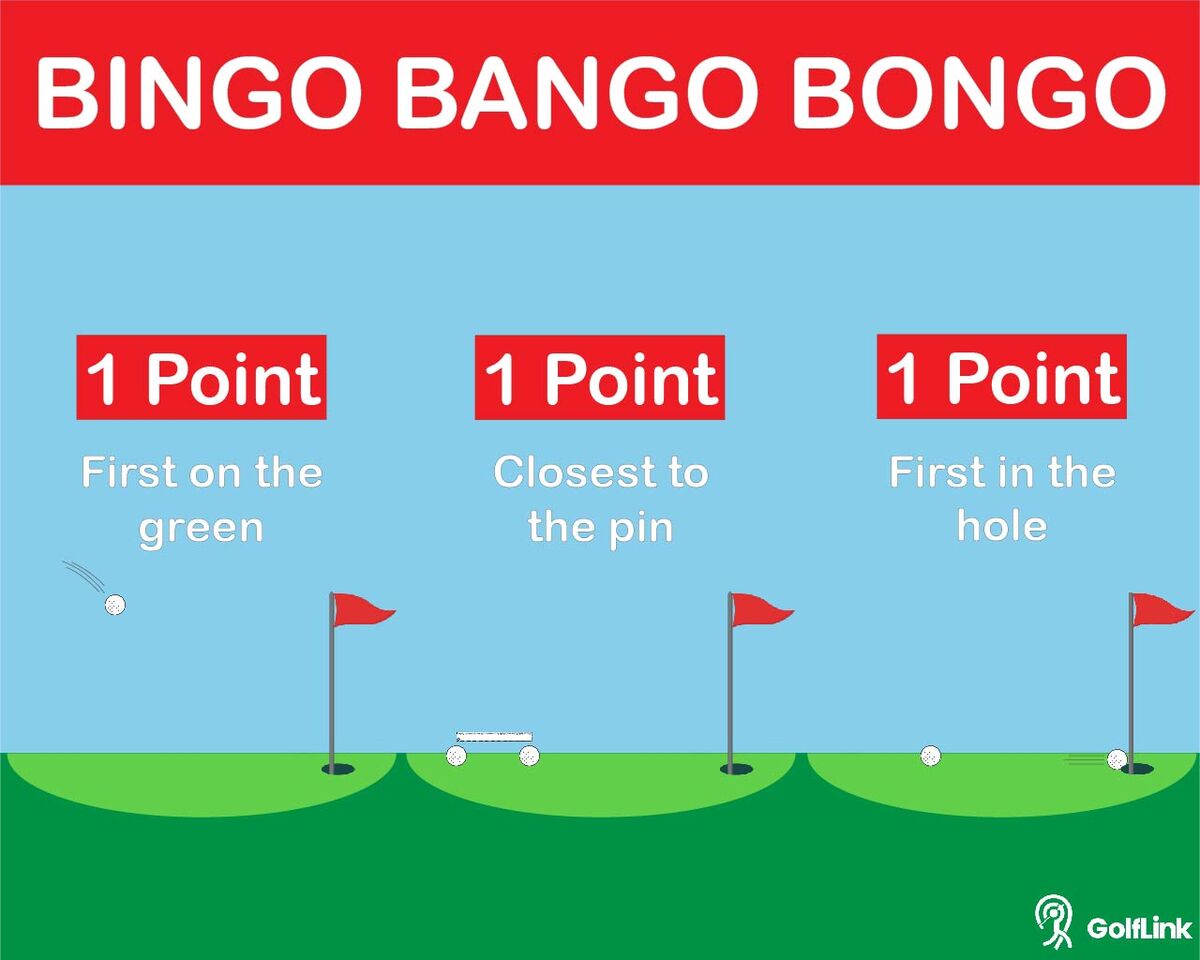
The key to Bingo Bango Bongo is to be first in all situations. The points available on each hole are:
- Bingo: The bingo point is awarded to the first golfer to land their ball on the green.
- Bango: Once all golfers are on the green, the bango point goes to the golfer whose ball is closest to the pin. Note: fringe does not count.
- Bongo: The first golfer to hole their ball earns the bongo point.
There are several ways you can adjust the points before starting your round. Most commonly, if a player gets all points on a hole they are awarded six total points instead of three.
Designate one player keep track of points and call them out after each hole. Having multiple people trying to keep track of points can cause confusion.
9. Scramble
SCRAMBLE RULES
Players: 4-plus
Vibe: Welcoming
If you’ve played in a golf outing, chances are you’ve used the Scramble format. It’s designed for the lowest scores possible, and keeps golf outings moving at a good pace of play.
The Scramble format is scored by strokes, but instead of counting individual strokes, your team combines to make each hole’s score.
- Each player hits their tee shot.
- All golfers play from the tee shot of the team's choosing.
- Continue this shot selection until the ball is holed.
One popular strategy for a Scramble is to have your best player or longest hitter tee off towards the end of the rotation. This allows the players in the front end of the rotation to concentrate solely on getting the group in a safe position before the better players can unleash big drives or take aggressive lines to the hole.
10. Nassau
NASSAU RULES
Players: 2-plus
Vibe: Competitive
Playing Nassau is a time-honored tradition for many golfers as it’s one of the most popular simple and golf games. This three-part game is fun because it allows players to recuperate after a tough front nine.
- In a Nassau, there are separate wagers for the front nine, back nine, and the entire 18 holes.
- It can be played between individuals or teams and is made even more exciting by the press. Pressing is when the trailing individual or team elects to play a hole for double.
- Nassau is a point-based game that has variations, but elements of Bingo Bango Bongo can be incorporated as well as just making each hole worth a specific amount of points.
11. Shamble
SHAMBLE RULES
Players: 4-plus
Vibe: Welcoming, Different
A fun alternative to a Scramble is the “Shamble” playing format.
- Each player tees off.
- Like a scramble, each player plays from the location of the best shot.
- From there, each player holes out their own ball.
- The best individual score becomes the group’s score for that hole.
12. Chapman
CHAPMAN RULES
Players: 4-plus
Vibe: Welcoming, Different
The Chapman format is part Scamble and part Alternate Shot consisting of two teams of two.
Once the teams are settled have been determined, here’s how to play:
- Everybody tees off.
- Each player then hits their partner's ball on the second shot.
- Scramble format is used for the third shot. Teams choose which third shot is best, and both play from there.
- From this shot until the ball is holed, only one ball is in play per team, and Alternate Shot is used until the hole is completed. If you selected Player A's third shot, Player B plays the next shot.
13. Stroke Play
STROKE PLAY RULES
Players: Any
Vibe: Competitive
Stroke play is the most basic format of golf in the United States, but if you've given each of the previous dozen games a try, it may feel like a refreshing change of pace.
Just add up the number of strokes over your round and the lowest score wins. It’s always fair to assign strokes to individual players based on handicaps.