How Long Does 18 Holes of Golf Take? 8 Variables to Consider
Here's the average time for 18 holes of golf, plus what to expect for faster and slower rounds.
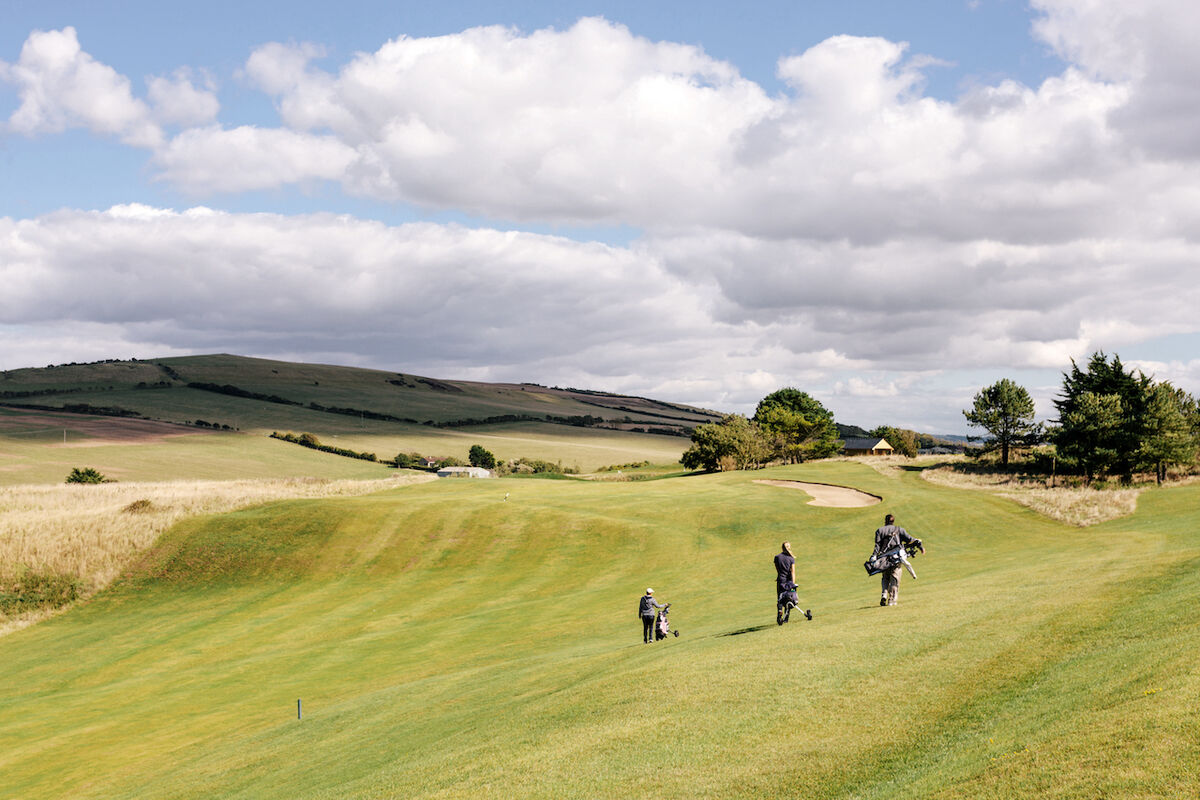
Curious how long it takes to play 18 holes of golf? We’ve got you covered. The average time for 18 holes of golf is about 4 hours and 10 minutes. Quicker rounds can take around 3 hours and 30 minutes and longer rounds can inch close to 5 hours.
Clearly there are plenty of variables that influence how long a round of golf takes. These eight factors help determine how long it takes to play 18 holes of golf.
- Golf course traffic
- Tee time intervals
- Time of day
- Day of the week
- Size of group
- Riding vs. walking
- Type of course
- Skill level
If you break your 4 hour and 10 minute round of golf down, each hole should take about 12-14 minutes to play. Long par-5 holes should be at the top end of that spectrum, while shorter holes and par-3s should be at the faster end.
However in golf, as in life, things don’t always go as planned. Here's how eight variables impact how long it takes to play 18 holes of golf.
1. Golf Course Traffic
Golf course traffic, perhaps the biggest factor that impacts pace of play, is completely out of your control.
On a very busy course, players could wait for the group ahead of them to clear the fairway for up to five minutes on each tee box before starting the hole.
Adding this on top of the normal 12-14 minutes for each hole can push a round to the excruciating five-hour neighborhood. There’s not much you can do to overcome an overcrowded golf course once you’ve started your round.
2. Tee Time Intervals

Tee time intervals have a huge influence on how long a round of golf takes, because that’s what determines just how much traffic is on the golf course.
When you book your tee time, find out what the facility's tee time intervals are. Either ask the pro shop if you book over the phone, or if you're booking online, check how much time is between each available tee time.
If the course is sending foursomes off every seven or eight minutes on a weekend and there's a full tee sheet, you're guaranteed to be in for a long round.
However, if groups are spaced out, with tee times every 10-12 minutes, your day will be much more enjoyable.
3. Time of Day
Certain times of the day are busier than others. Golf courses are most crowded from 7:00 a.m. until mid-afternoon. If you're an early bird, try to snag a tee time before the rush and enjoy a round with nobody in front of you.
If you're the happy hour golfing type, put your tee time off until the afternoon. If you try to time your round so you finish with less than an hour of daylight left, you're likely to enjoy a good pace of play.
4. Day of the Week
It's no surprise that most golf is played on the weekends. If you can manipulate your schedule to carve out some time to play golf during the week, you can benefit from a quicker round, as you won't fight nearly as much course traffic.
5. Size of Group

The 4:10 round is a reasonable expectation for a foursome. A smaller group should expect a slightly quicker round. A twosome or threesome could play in three to four hours, depending on the pace of the groups ahead of them.
A single player can play as fast as the players in front allow. It's not unheard of for a single player to finish a round of golf in two hours or less.

Pace of Play Techniques: How to Speed Up Your Game
6. Riding vs. Walking

If you're using a golf cart, you can cut down on the time between shots, and play much quicker than if you're walking. In theory, a riding round should take less time than walking.
This theory doesn’t always pan out, however. When course traffic ahead of you prevents you from cruising through the course, you’ll have to pump the brakes.
You also need to look out for cart-path-only restrictions when course conditions are soggy. In this situation, riding can actually take longer than walking. If your ball is in the left rough, and the cart path is on the right side of the hole, you'll have to walk up to 50 or 60 yards to your ball, then back to the cart. You better make sure to bring all the clubs you might need because you won't want to repeat that walk when you realize the club you need is still in the cart.
7. Types of Courses
A full par-72 course takes just over four hours to play, but a par-3 course with 18 holes can be completed in around two hours. The shorter the course, and the more par-3 holes, the faster the pace of play should be.
8. Skill Level

Simply put, a group of lower-handicap players should play quicker than a group of high-handicap players or beginners. Most of this time differential comes from searching for golf balls.
The Rules of Golf allow up to three minutes to search for a lost golf ball. If four beginning or high-handicap players make up a group, there’s a good chance that at least one person will be searching on almost every hole, which is another huge factor in dictating pace of play, not only for your group, but for all the groups behind.