
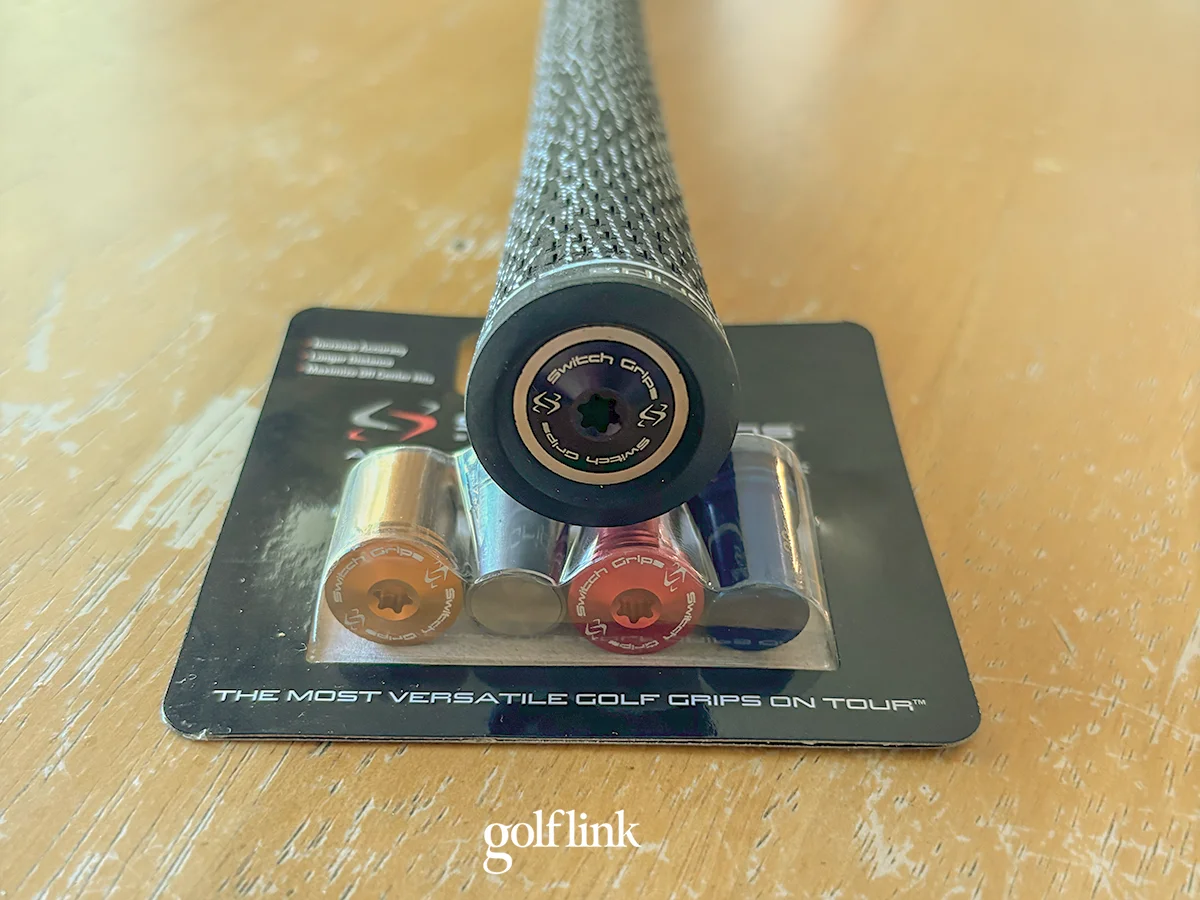
SwitchGrips promises faster swing speeds, higher ball speeds, more distance and straighter shots. How can a grip do all that, you ask? By swapping between 2g and 20g weights in the butt of the grip. Theoretically.
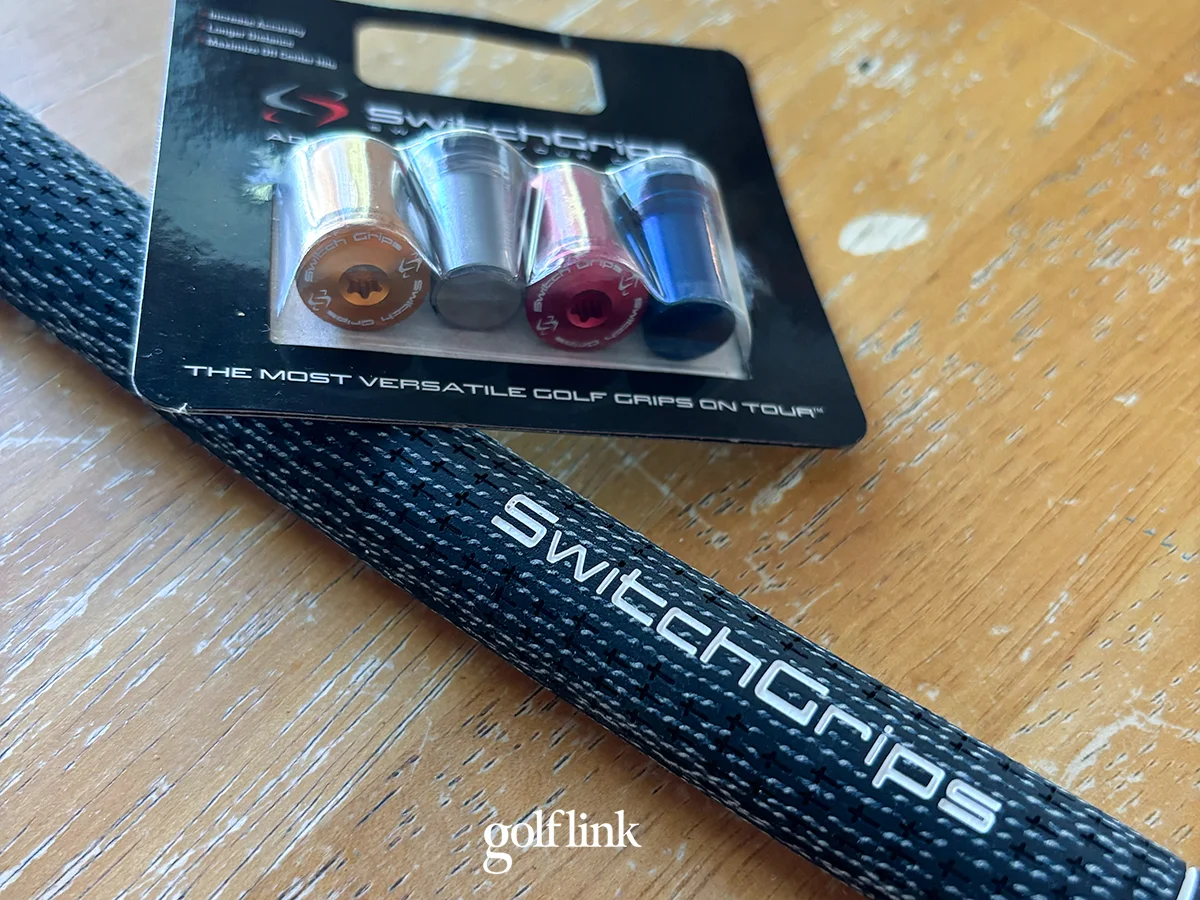
Counterbalancing isn't new. Weight near your hands moves the balance point up the shaft, which is supposed to help boost swing speed and potentially help you square the face more consistently. SwitchGrips adds adjustability to counterbalancing: the interchangeable 2g, 4g, 8g, 14g and 20g weights can be swapped in minutes just like you can change your driver’s loft, lie, or shot-shape bias with the twist of a wrench.
But we don’t take claims as fact, so I got a sample of grips and weights from SwitchGrips, put them on my favorite test clubs, and collected strike and launch monitor data with every available weight.
I wanted to know two things: can changing the weight actually move strike location? And does using SwitchGrips actually deliver on its promise of more distance, ball speed, club speed and accuracy?
SwitchGrips Specs

- USGA conforming: Yes
- Package options: Distance Kit (4 grips + 4 weights); Precision Kit (8 grips + 8 weights); Tour Kit (12 grips + 12 weights) Weight kits are also sold separately
- Weights: 4g, 8g, 14g, 20g, plus the standard black insert (2g)
- Sizes: Standard or Midsize (+1/16"). For Jumbo add four extra wraps of tape under Midsize.
- Grip options: Full Rubber, Full Cord, Hybrid, Putter
- In the box: Grips, weights, wrench
- Guarantee: 30-day money-back
- What I tested: Two Standard-size hybrid swing grips with every weight
How I Tested
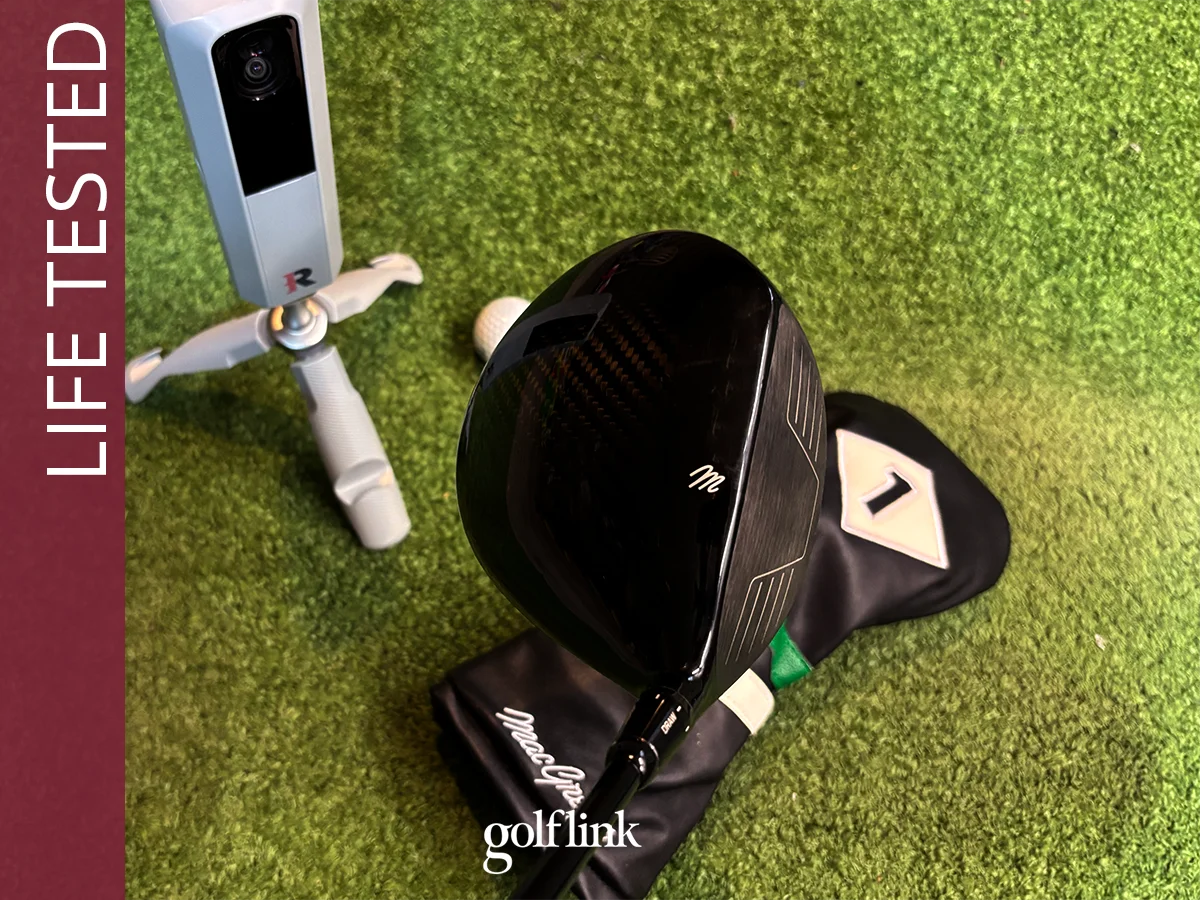
I installed two standard-size SwitchGrips, one on a shortened driver that’s sized to be swung in a garage, and one on a Callaway Paradym Ai Smoke 7-iron (strong loft, game-improvement build).
For each weight, I sprayed the clubface to get a clear picture of how the strike location moved. I hit five 7-irons at a 160-yard target on a SkyTrak ST Max launch monitor. After each set, I exported the data, photographed the face, and wiped and re-sprayed it. Then I ran the driver through every weight the same way, hitting four shots each, working up from the standard insert to 20g.
A handful of swings per weight isn't a lab study. But it's enough to see if swing speed and ball speed change as weight changes, and if having several weight options in the grip gave me a ball-striking advantage.
Verdicts and comparisons are measured against the standard black insert (2g), which is aligned with a standard grip weight.
SwitchGrips also sent me a putter grip with the same technology, which I will test and review in a separate article.
Installation: Bring Patience
I've installed close to 100 grips over the last five years, and these were noticeably harder than most. Both grips really struggled to get over the butt of the shaft with two wraps of tape. But eventually I got the job done.
Can You Move Your Strike Location?
The most convincing conclusion I got from my SwitchGrips test is that yes, you can influence your strike location by testing different weights in the grip. And if you can move your strike location, that means you identify and select the best one.
With the standard insert, my 7-iron pattern was the widest of the test, spread from the upper heel toward the toe.
As I added weight, the pattern dropped down the face – improving fat shots – and got smaller, more concentrated around the sweet spot.
With 8g, my strikes centered up in the middle of the face. As the weight got heavier, from 14g and then 20g, strike location moved down the face. Changing nothing but a few grams in the grip moved my contact from high on the face to the bottom of it.
On the driver, the weight changed how spread out my strikes were. With the standard insert and 4g, misses drifted low and on the heel. With 8g and 14g, they pulled into a single cluster near the center. With 20g, they spread back out.
I didn't walk away with a perfect strike pattern from any single configuration, but I did walk away with a clear conclusion: weight in the grip influenced my strike location. My pattern was clear: more weight in the butt meant lower strikes on the face with the 7-iron, and my testing data and strike locations can point me to the best configuration for my swing.
Every golfer’s swing will vary, but what matters is that the weight is a lever that clearly moves it, and SwitchGrips gives you a menu of five strike patterns to choose from.
Club Speed and Ball Speed
Here's where the claims meet the launch monitor.
7-iron (five-shot averages):
Weight | Club Speed | Ball Speed | Carry | Total |
Standard (2g) | 86.0 mph | 109.2 mph | 158.6 yd | 163.4 yd |
4g | 86.8 mph | 107.4 mph | 154.0 yd | 159.2 yd |
8g | 87.0 mph | 110.6 mph | 160.0 yd | 165.4 yd |
14g | 85.4 mph | 108.2 mph | 156.2 yd | 161.6 yd |
20g | 85.4 mph | 103.2 mph | 146.0 yd | 165.4 yd |
My 7-iron club speed moved, but barely. Regardless of weight, my swing speeds finished within 1.0 mph of the baseline speed I recorded with the standard weight. That could be a benefit of the counterbalance, or normal swing-to-swing variation.
Ball speed moved more, but not the way counterbalance theory predicts. The 8g weight edged the standard insert by about 1.4 mph and 1.4 yards of carry. That’s a small gain, but I subscribe to the theory that improving at golf comes down to stacking as many small gains as possible, so I won’t discount it.
Meanwhile 20g was clearly too much for me to handle, returning a lower swing speed than the baseline weight, worse strike, and the shortest carry distance of the 7-iron test. This result is more evidence that SwitchGrips make a difference in strike quality. The heaviest option was the worst for me but it could be just right for someone else. The appeal is having the opportunity to find something that works better for your swing than the status quo.
Driver (four-shot averages):
Weight | Club Speed | Ball Speed | Carry | Total |
Standard (2g) | 89.0 mph | 126.0 mph | 189.5 yd | 198.3 yd |
4g | 91.3 mph | 124.0 mph | 184.5 yd | 192.8 yd |
8g | 91.0 mph | 127.8 mph | 192.3 yd | 199.3 yd |
14g | 91.5 mph | 129.3 mph | 197.0 yd | 207.5 yd |
20g | 89.5 mph | 126.5 mph | 192.3 yd | 201.0 yd |
My driver test made the best case for SwitchGrips. The 14g weight gave me 2.5 mph more club speed, 3.3 mph more ball speed and 7.5 more yards of carry than the baseline weight.
That backs up SwitchGrips’ claim. Going one step further to the 20g weight, I gave almost all of it back. And the 4g weight shows why club speed alone isn't the story: I swung it 2 mph faster than the standard insert, but struggled to find the center consistently, so it produced my slowest ball speed and shortest carry of the day.
Are the Claims Legit?
SwitchGrips makes a lot of bold claims right on the packaging: more club speed, more ball speed, more distance and improved accuracy. That’s what every golfer wants, so here’s how those claims checked out.
Quick note, within both my 7-iron and driver test, one single weight provided the best results for club speed, ball speed, distance and accuracy. In the 7-iron test, the 8g weight was best across the board. In my driver test, the 14g weight was best across the board. Those results are compared to the baseline insert (which achieves a standard weight and balance) to determine whether the claims proved true.
Here’s what I found.
Claim | 7-Iron | Driver | Verdict |
More Club Speed | +1.0 MPH (within normal variation) | +2.5 MPH | Partly |
More Ball Speed | +1.4 MPH (within normal variation) | +3.3 MPH | Partly |
More Distance | +1.4 yds carry (within normal variation) | +7.5 yds carry | Partly |
Improved accuracy | 7.0 yards closer to center | 6.2 yards closer to center | Yes |
Verdicts compare my best-performing weight to the standard black insert. Numbers are averages of every shot: five per weight with the 7-iron, four with the driver. Accuracy is the average distance offline, left or right.
Before I tested SwitchGrips, I predicted that I would see improvements in most areas the brand claims, but I suspected the gains would be minimal. For the most part, that’s what the data confirmed. The 7-iron gains I saw in testing aren’t likely enough to notice on the golf course, except that accuracy advantage.
The driver gains are a little more compelling. My optimal weight returned 7.5 yards more carry and better accuracy over the baseline, which should be enough to get any golfer excited.
Accuracy
Accuracy is where SwitchGrips earned its keep. With the 7-iron, the 8g weight was my straightest setting: my average miss was five yards offline, seven yards better than the 12 yards offline average with the standard insert. Fortunately, that’s the weight that produced optimal speed and ball striking as well. In fact, in my 7-iron testing, every weight produced better accuracy than the baseline insert. That’s enough to make me question the setup in my bag, since accuracy with irons has a big influence on my scores.
With the driver, 14g was straightest, shrinking my average miss from 13 yards to about seven. Once again, 20g was my most scattered driver setting. That cements the fact that this is not simply a linear “more is better” equation. There’s an optimal weight, and once you stray too far from it in either direction, strike quality, ball speed, and accuracy all suffer.
How It Feels
The heavier weights lower swing weight, but I never felt the clubhead get lighter. I just felt a heavier overall club, and the extra effort to swing it.
The metal ring the weights screw into sits right on top of the shaft, and you can feel it at times.
I also wish the empty grip weighed 4 to 8 grams less than a standard grip, so you could test a weight that’s lighter than stock, not just heavier.
The Bottom Line
The value of SwitchGrips isn't that it makes everyone longer and straighter. It's the range of options it puts at your fingertips. Your current grip gives you one option, SwitchGrips gives you five. If it’s a sheer numbers game, I like most people’s chances of finding one that produces better results than a standard weight.
In my testing, swapping weights moved my 7-iron strike from too high on the face to down on the proper groove, improved my 7-iron accuracy by seven yards, and increased my driver carry by 7.5 yards. Those are meaningful gains to pick up with the turn of a wrench.
Where you land in that range depends on your swing, but don’t expect one weight to be the best fit for every club. My 7-iron fit 8g, and my driver fit was 14g. Both beat the standard insert, most clearly on accuracy.
But my speed and distance gains over stock were modest, and barely measurable with the 7-iron, and that gives reason for pause. If the best setting for a lot of golfers lands close to stock, it’s an expensive experiment when a standard grip costs under $10.
If you're a tinkerer who wants to grab every last yard of distance and accuracy, and every last mile per hour of club and ball speed, SwitchGrips is the easiest way I've found to squeeze a little extra juice out of your equipment.
Test every weight and let the numbers decide.