Ryder Cup Format & Scoring Explained
The Ryder Cup is three days of fierce, can't miss competition. Here's the recipe.
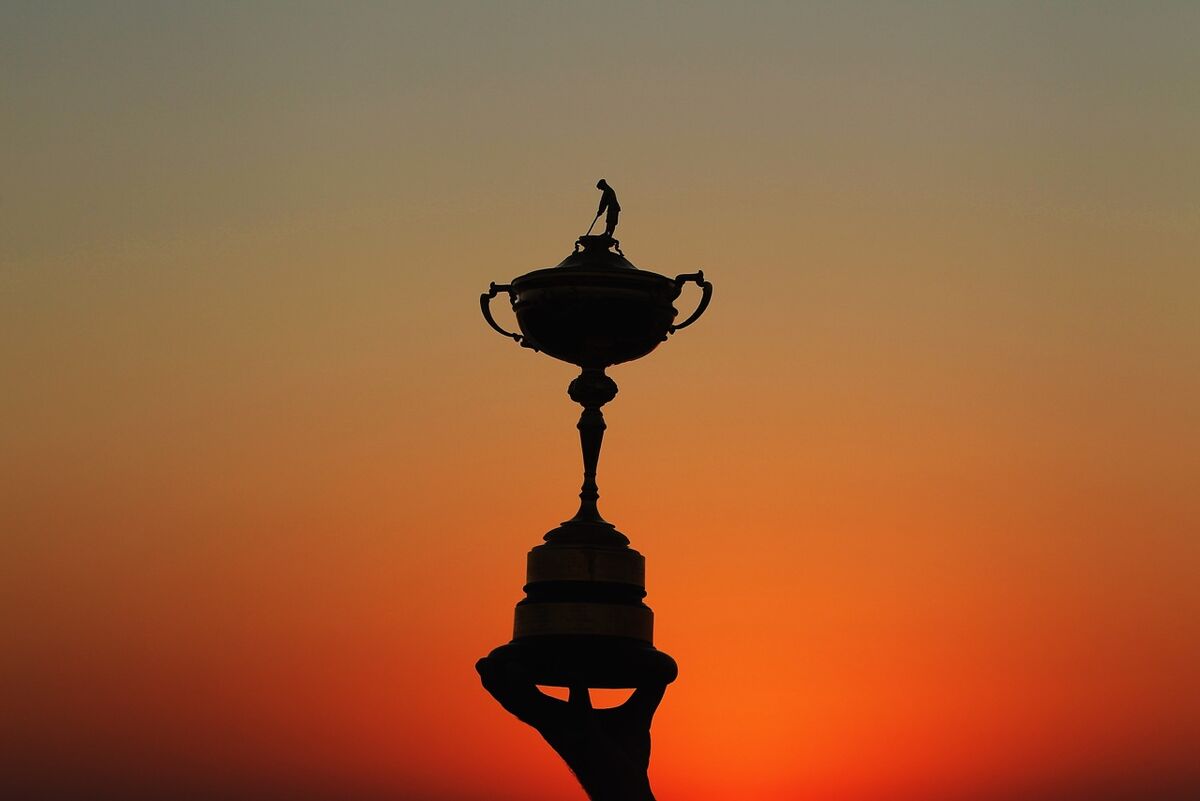
There’s one golf tournament every-other year that attracts the rowdiest crowds and gives fans a World Cup style spectacle: the Ryder Cup. The bi-annual exhibition between the best professional golfers from the United States and those from Europe is appointment viewing for avid golfers and casual fans alike.
The recipe for the Ryder Cup’s success is simple: start with one part golf; add a team element; convert stroke play to match play; spice it up with four ball, alternate shot, and individual match play; pour in the Patriotism generously and stew for two years. Voila, the result is a can’t-miss golf spectacle.
Ryder Cup Format
The Ryder Cup alternates between four ball and foursomes over four sessions during the first two days, and ends with 12 individual matches.
|
Day |
Session |
Format |
Number of Matches |
|
Friday |
Morning |
Fourball or Foursomes |
4 |
|
Friday |
Afternoon |
Foursomes of Fourball |
4 |
|
Saturday |
Morning |
Fourball or Foursomes |
4 |
|
Saturday |
Afternoon |
Foursomes of Fourball |
4 |
|
Sunday |
All Day |
Singles |
12 |
Foursomes
Also known as alternate shot, in this format teammates alternate tee shots with Player 'A' teeing off on odd-numbered holes, and Player 'B' teeing off on even-numbered holes.
After the tee shot, teammates alternate hitting shots until completion of the hole. The team with the lower score on the hole wins the hole.
Holes can be tied (formerly referred to as halved). The team that wins the match receives one point, and if the teams tie they each get a half-point.

Foursomes in Golf: A Confusing Name for a Simple Format
Four Ball
In the four ball format, all four players in the group (two from each team) play their own ball.
The team whose player has the lowest score wins the hole. Holes can be tied (formerly referred to as halved). The team that wins the match receives one point, and if the teams tie they each get a half-point.

Four-Ball in Golf: Rules & Strategies for Match and Stroke Play
Singles
Players compete in match play head-to-head. The best score on each hole wins that hole. Holes can be tied (formerly referred to as halved). The player who wins the match earns one point for his team.
Ties are worth 1/2 point to each team.
Ryder Cup Scoring
There are 28 total matches in the Ryder Cup, and therefore 28 available points.
The first team to reach at least 14.5 points wins. If the teams tie (14-14) the team that last won the tournament retains the Ryder Cup trophy.
Of course, it’s always preferable to win the Ryder Cup rather than to retain it.
Selecting Ryder Cup Teams
Each team has a captain, and it's the captain's job to decide which players play together during four ball and foursomes matches, and in which order they compete in singles matches.
Ryder Cup players are selected through a years-long qualifying process in which points are earned based on money made in major championships and regular PGA Tour events, weighted to favor recent success and reward recent success and major winners.
In the past, eight players from the United States qualified through points, with the captain selecting players for the remaining four spots.
However, when the 2020 Ryder Cup was pushed to 2021 due to the coronavirus pandemic, the United States announced that just six players would qualify through points, and captain Steve Stricker would make six captains picks instead of four. Zach Johnson, Team USA's 2023 Captain, kept the format of six captains picks for the 2023 edition of the Ryder Cup, and that strategy is continuing at least through the 2025 Ryder Cup at Bethpage Black with Captain Keegan Bradley.
The Europeans also employ a points system, with the top three players from the European Points List and the top five from the World Points List automatically qualifying, leaving six captains picks.

American Golfers With the Most Ryder Cup Appearances & Points
Ryder Cup History
The Ryder Cup is a bi-annual match-play competition between the United States and Europe. The competition is named after golf enthusiast and businessman Samuel Ryder, who donated a solid gold trophy for the winning team. The first official Ryder Cup was contested in 1927 at Worcester Country Club in Worcester, Massachusetts.
The Ryder Cup was strictly U.S. versus Great Britain until 1979, when a rules change allowed all continental European professionals a chance to qualify.
The Ryder Cup stands at 27 wins for the United States, 16 wins for Great Britain/Europe and two ties. The event was not played from 1939 to 1945 due to World War II and in 2001 due to the World Trade Center attacks.
Ryder Cup Winners By Year
Location & Future Sites
The Ryder Cup is played every other year, alternating locations between the United States and Europe. The 2023 Ryder Cup is to be played at Marco Simone Golf & Country Club in Rome, Italy.
Here are the future Ryder Cup Sites that have been announced:
| Year | Course | Location (Host) |
| 2027 | Adare Manor | County Limerick, Ireland (Europe) |
| 2029 | Hazeltine National GC | Chaska, Minnesota (USA) |
| 2031 | Carimal | Carcelona, Spain (Europe) |
| 2033 | The Olympic Club - Lake Course | San Francisco, California (USA) |
| 2035 | TBD | Europe |
| 2037 | Congressional CC (Blue) | Bethesda, Maryland (USA) |