How to Grip a Golf Club: Step-By-Step Tips
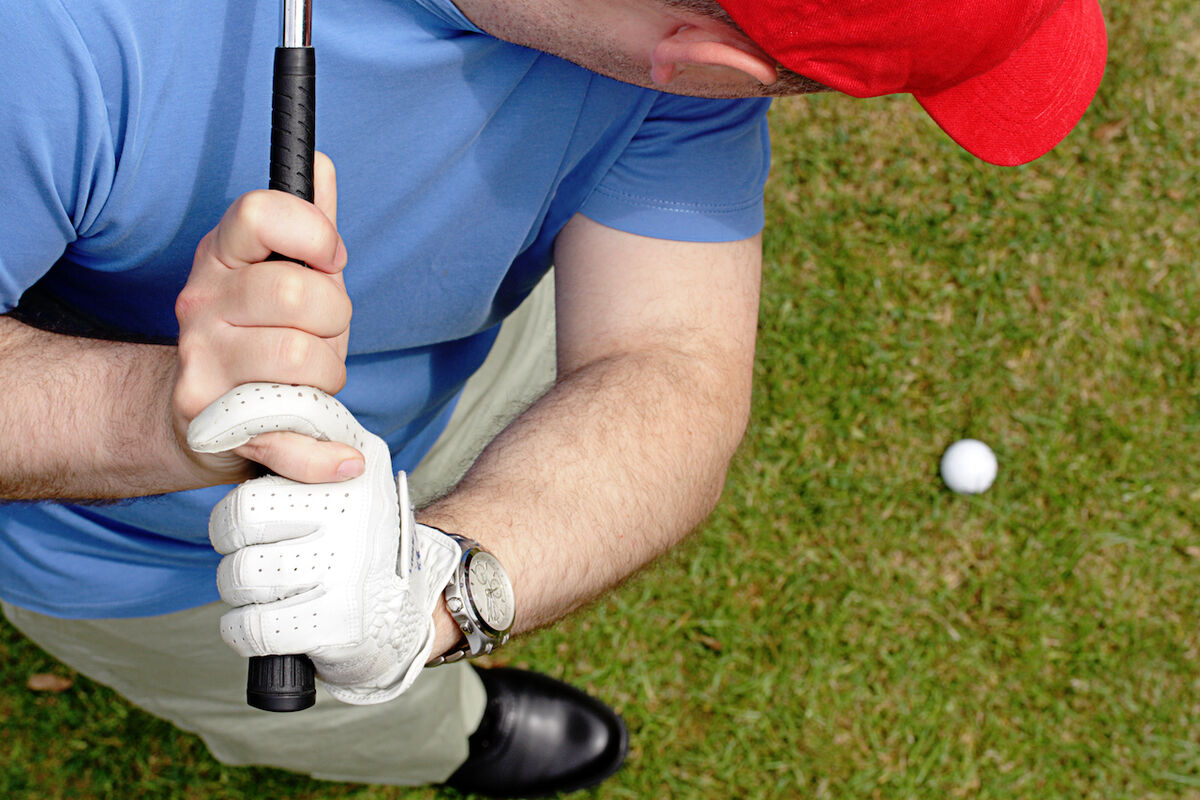
Many golfers don’t give their grip much thought, but the truth is the success or failure of a golf shot can often be determined by the grip. Unfortunately, golfers spend months or even years battling problems that can be solved with a proper grip.
The good news is that this means that by utilizing a sound grip, you can increase your chances of a successful shot before you even begin your takeaway.
Importance of the Grip
The grip is your primary control of your club face, which has the greatest impact of any variable on which direction your ball flies. This is arguably the single most important element of the golf swing because no matter how well you strike the ball, if it doesn’t fly where you aim, you probably won’t be happy with the result.
How to Hold a Golf Club
There are many variations of a proper golf grip, but before we can go into those, we must establish the baseline of a neutral grip. A neutral grip is one that produces a square clubface throughout the swing. The grip alone cannot dictate if the clubface is square to your target, but in a neutral grip the clubface will be square to your lead wrist. If you use a neutral grip, your lead wrist controls the line of your shot.
Step 1: Left Hand Grip
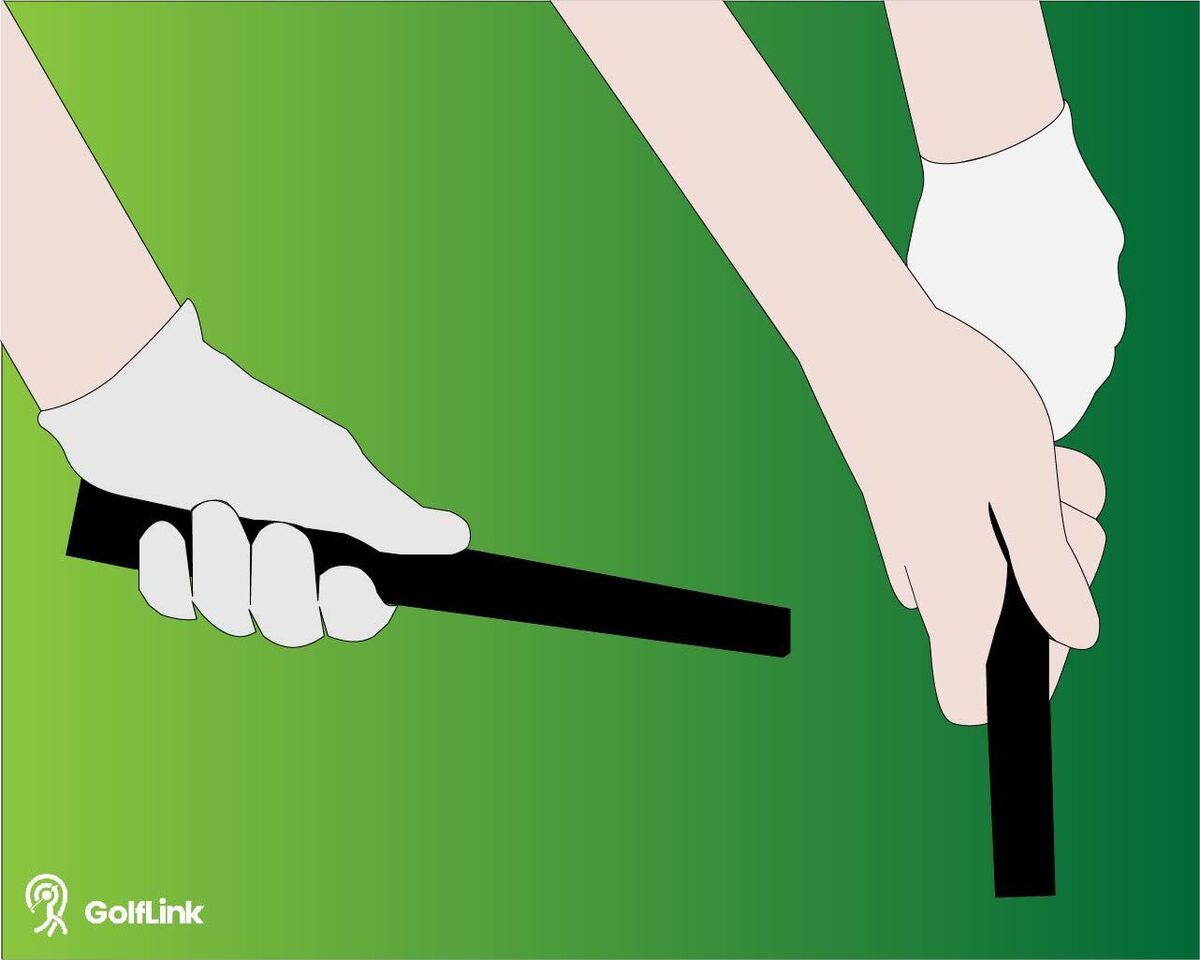
To take a neutral golf grip for a right handed player, first grab the club with your left hand. If you wear a golf glove, this will be your glove hand and it’s your top hand in the golf swing. Grip the club in the fingers and underneath the heel pad of your left hand, so your heel pad is on top of the golf club. Gripping the club in your fingers allows you to hinge the club properly in the swing.
Step 2: Right Hand Grip
Next, grip the club in the fingers of your right hand over the left thumb so the “lifeline” of your right hand sits over your left thumb.
It’s important to make sure to “lightly pinch” the thumb and index finger together. At the top of your backswing, your thumbs will support the weight of the club.
The “Vs” of the Golf Grip
When discussing your golf grip, you’ll often hear people refer the the “Vs” and where they point. This refers to the “V” shape created by your thumb and index finger when it’s on the golf club. A great checkpoint before you begin your swing is to make sure the “Vs” in both hands are pointing towards your trail shoulder.
Grip Pressure
On a scale from 1-5 where, where “one” is as light as you can hold the club, and “five” is as tight as you can hold it, aim for grip pressure of about a three. Feel free to experiment with different grip pressures to find what works best for you, but focus on maintaining a consistent grip pressure throughout the swing. Sudden tension in the grip during the swing can lead to many swing flaws.
There is Not One Correct Grip
A good grip is one that helps you hit the ball straight. If you’re striking the ball well but not satisfied with where it’s going, experiment with different grips, or even adjust your grip position to manipulate ball flight.
The Vardon Grip
The Vardon Grip is perhaps the most commonly used grip in golf, and is also known as the overlapping grip. That’s because the pinky finger of your dominant hand (right hand for a right-handed golfer) overlaps the index finger of your opposite hand, resting between the index and middle fingers.
The Interlocking Grip
In an interlocking grip, the pinky finger of your dominant hand interlocks with the index finger of your opposite hand, as opposed to the Vardon Grip when it overlaps. To set up with an interlocking grip, slip the index finger of your lead hand on top of your dominant hand, in between the knuckles of your pinky finger and ring finger. The pinky finger of your dominant hand will then rest between the knuckles of your index and middle fingers of your lead hand.
Adjust Your Grip For Straighter Ball Flight
While the grip is your connection to the golf club, and dictates the direction you ball flies, there are other factors that impact ball flight as well. If you practice with a neutral grip and make solid contact with the ball, yet it doesn’t fly straight, you can manipulate your grip to control your ball flight before tweaking other elements of your swing.
Strong Grip to Fight a Slice or Push
The terms “strong” and “weak” grip don’t refer to grip pressure, but where on the club your hands sit. If you fight a slice or have the tendency to push the ball, utilizing a strong grip can help you.
To take a strong grip, grip the club using the same fundamentals described for a neutral grip, then rotate both hands to the right (for a right-handed player) on the club, without manipulating the clubface itself. Begin by rotating your hands until the next knuckle becomes visible at address, and adjust from there as needed.
Pushes and slices are caused, at least in part, by an open clubface at impact. A strong grip will help the clubface properly close through impact, eliminating your push or slice.
Weak Grip to Fight Hooks and Pulls
The same logic as above applies to hooks and pulls, but with the opposite adjustments. If you tend to pull or hook the ball, your clubface is closed to your target through impact. Adjust to a weak grip by rotating your hands to the left (for a right-handed player) until one less knuckles is visible at address. This will help prevent over-rotation of the clubface through impact, and should lead to a more square clubface and straighter shots.
Golf Grip Trainer
Learning the proper grip is great, but to really elevate your game, you must be able to make the proper grip consistently without even thinking about it. Gripping your golf club perfectly every time should be as routine as getting in your car, buckling up, and starting the engine. You probably don’t put much conscious thought into that, and you probably don’t mess it up very often, either.
To help make the perfect golf grip second-nature, SKLZ has created the Golf Grip Trainer. This training aid attaches to your club and locks your hands into the proper grip. The Golf Grip Trainer includes an alignment market to indicate the proper placement on your club, and for your hands. The device can be adjusted to teach a neutral, strong, or weak grip for right-handed players, but does not fit left-handed players.
The Grip Trainer, which costs around $15, has gotten many positive reviews, and with over 3,500 reviews on Amazon, has a rating of 4.1 out of 5 stars. Many reviewers recommend the Golf Grip Trainer for beginners, as learning the proper grip from the beginning makes the game much easier and more enjoyable.